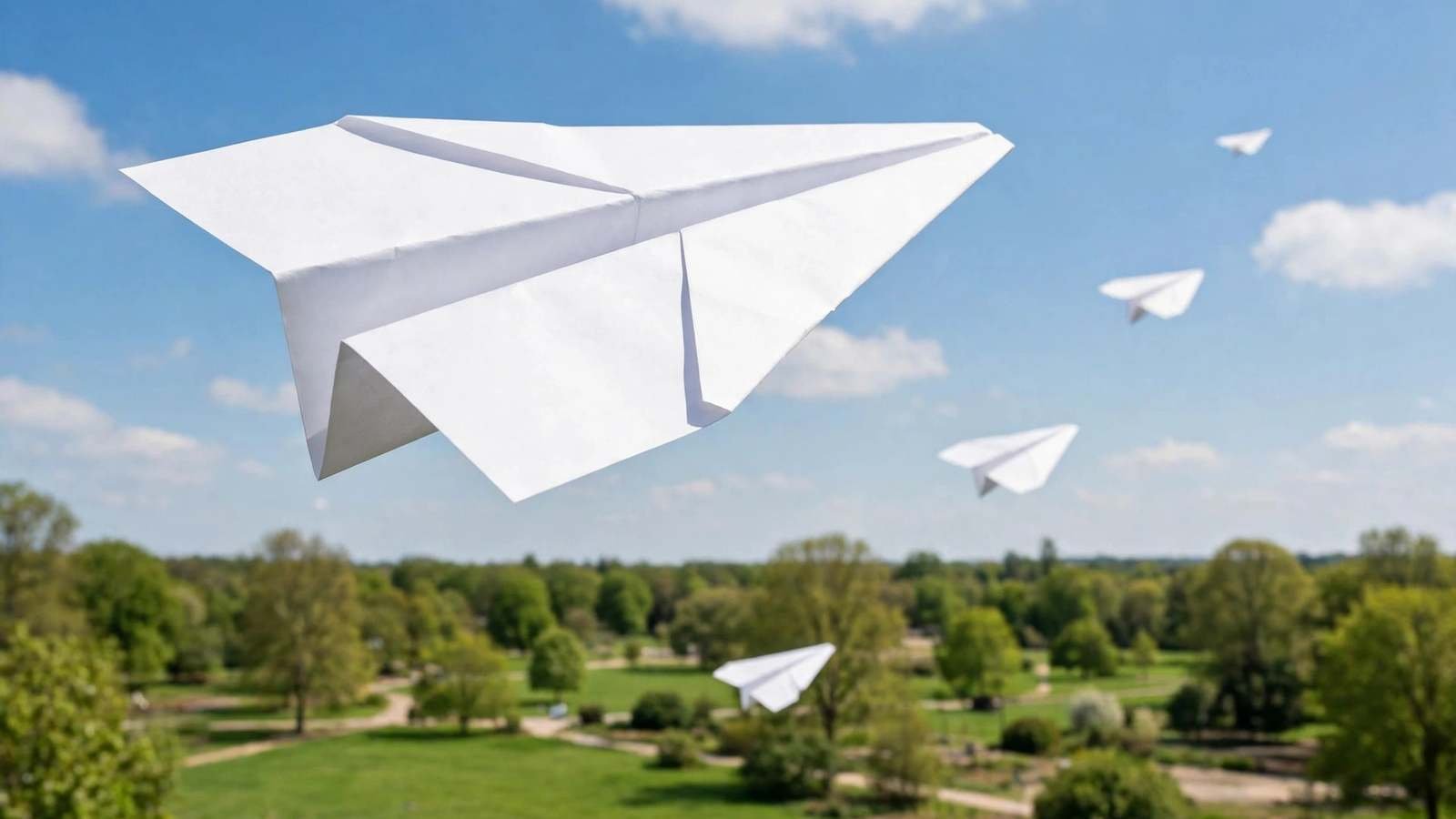
A paper airplane is a small miracle. One sheet of paper, a few folds, and a gentle throw can send it gliding across a room, a garden, or a school hall. The best paper airplanes are not luck. They follow simple rules about folds, balance, and throwing.
In this guide you will learn how to make a paper airplane that flies far, step by step. You will build the classic dart, learn a long distance glider variation, and discover how to throw, tune, and fix every common problem. All you need is one sheet of paper and a flat table.
What You Need
Start with one sheet of plain printer paper, letter or A4 size. Plain paper works better than thick card, because thick paper is heavy and hard to fold sharply. You also need a flat table, and your fingernail or the edge of a ruler to press each fold flat. A small paperclip is optional, and it can add weight to the nose for longer flights.
Work on a clean, flat surface. Folds made in the air come out uneven, and uneven folds make crooked flights. Take your time with the first folds, because the whole airplane depends on them.
How to Make a Paper Airplane Step by Step
Step 1: Fold the paper in half lengthwise.
Place the paper flat with the long edge facing you. Fold the left edge over to meet the right edge, so the paper becomes long and narrow. Press the fold firmly with your fingernail. Then open the paper again. The crease down the middle is your guide line for every fold that follows.
Step 2: Fold the top two corners to the center.
Take the top left corner and fold it down so its edge lines up with the center crease. Do the same with the top right corner. The top of the paper now looks like a pointed roof. Press both folds flat. These two folds form the nose of the airplane.
Step 3: Fold the pointed top down.
Take the pointed tip at the top and fold it down toward you, so the point meets a spot about two finger widths above the bottom edge. Press the fold flat. This fold gives the airplane a blunt nose, which flies straighter than a sharp point.
Step 4: Fold the new top corners to the center.
You now see two fresh corners at the top. Fold the left one down to the center crease, and fold the right one down the same way. Leave a small triangle of the earlier fold peeking out below the point. Press both folds firmly.
Step 5: Fold the small triangle up to lock the folds.
Take the small triangle sticking out at the bottom of the point and fold it upward over the two folds you just made. This little lock holds the nose together and stops the folds from opening in flight. Press it flat.
Step 6: Fold the airplane in half.
Flip the paper over, then fold the whole shape in half along the original center crease, with the locked triangle on the outside. The airplane now looks like a long wedge. Run your fingernail along the bottom fold to make it sharp.
Step 7: Fold the first wing down.
Hold the airplane with the folded bottom edge down. Take the top layer and fold it down so the top edge of the wing lines up with the bottom edge of the body. Press the fold flat. This is the first wing.
Step 8: Fold the second wing down.
Turn the airplane over and fold the other top layer down in the same way, matching the first wing exactly. Both wings should be the same size and angle. Uneven wings make the airplane turn. Press both folds firmly.
Step 9: Open the wings and check the shape.
Open both wings so they stick out flat, like a wide V when seen from the front. The wings should be level. The nose should be heavy and pointed. Your classic dart paper airplane is ready to fly.
How to Throw a Paper Airplane for Distance
Hold the airplane from underneath, near the middle, with your thumb on one side and two fingers on the other. Stand with your throwing arm slightly back. Throw gently and level, not hard and upward. A hard throw makes the airplane stall and drop. A smooth, level throw lets the air hold the wings.
Aim slightly upward, about ten degrees above level, and throw into calm air. Windy days push light airplanes off course, so throw indoors or on a calm morning for the longest flights. Let the airplane glide, and watch where it goes. The flight tells you what to fix.
The Long Distance Glider Variation
For longer flights, build a glider with wider wings. Start with the same first four steps, but in step seven, fold the wings down only halfway, so the wings stay wide and flat. A wide wing catches more air and glides farther, while a narrow wing flies faster but drops sooner.
Add a paperclip to the nose for extra weight. The clip pulls the nose forward and keeps the glider level. If the glider dives, move the clip back a little. If it stalls and drops tail first, move the clip forward. Small changes make a big difference.
How to Fix Common Paper Airplane Problems
Problem: The airplane dives straight down.
The nose is too heavy or the throw was too hard. Bend the back edges of both wings slightly upward, and throw more gently.
Problem: The airplane stalls and drops tail first.
The nose is too light. Add a paperclip to the nose, or bend the back edges of the wings slightly downward.
Problem: The airplane always turns left or right.
One wing is larger or more angled than the other. Refold the wings to match, and bend the back edge of one wing slightly to steer it straight.
Problem: The airplane flips over.
The throw was too hard or too steep. Throw level and gentle, with a smooth release.
Tips for Longer Flights
Press every fold sharply, because crisp folds make clean air flow. Use fresh paper without wrinkles, because wrinkled paper adds drag. Fly in a large open space, such as a hall or a calm garden, so the airplane has room to glide. Keep a record of your best flights, and change only one thing at a time, so you learn what each change does.
Try different paper sizes. A larger sheet makes a slower glider, and a smaller sheet makes a faster dart. Try folding the wings with a slight upward angle, called dihedral, which helps the airplane stay stable. Small experiments turn a simple toy into real learning.
The Science Behind Paper Airplanes
A paper airplane flies because of four forces working together. Lift pushes the wings up, and it comes from air moving over and under the wings. Drag pulls backward, and it comes from air pushing against the paper. Gravity pulls the airplane down toward the ground. Thrust pushes it forward, and it comes from your throw. A good flight happens when these four forces balance.
The center of gravity matters more than anything else. It is the point where the weight of the airplane balances. If the center of gravity sits too far forward, the nose dives. If it sits too far back, the tail drops and the airplane stalls. The paperclip trick works because it moves the center of gravity forward a little at a time. Wings matter too. Wide wings make more lift and glide farther. Narrow wings make less drag and fly faster. Folding the back edges of the wings, called elevons, lets you steer. Bending them up lifts the nose, and bending them down lowers it.
Paper Airplane Games and Challenges
Once your airplane flies straight, turn folding into games. Hold a distance contest and mark each landing spot with tape, so everyone can see the winner.Hold an air time contest and use a phone stopwatch to measure how long each airplane stays up. Try a loop contest and throw the airplane upward so it loops and returns.
Games teach faster than reading, because every flight gives instant feedback. A dive teaches you about nose weight. A stall teaches you about lift. A curve teaches you about uneven wings. Keep a small notebook of what you changed and what happened. The best paper airplane pilots are the ones who test, watch, and fold again.
Common Mistakes to Avoid
First, avoid folding in the air. Always fold on a table. Second, avoid uneven wings. Measure by eye and match both sides. Third, avoid throwing hard. Power is not the secret, smooth air flow is. Fourth, avoid thick or glossy paper. Plain printer paper beats fancy paper almost every time.
How to Build a Stunt Plane That Loops
Once your dart flies straight, try a stunt plane that loops in the air. Start with the same classic dart, but fold the wings with a slight upward tilt, and bend the back edges of both wings upward more than usual. The upward bend pushes the tail down and the nose up, so the airplane climbs, stalls, and dives in a loop. Throw it gently upward at a steep angle, and watch it roll over the top and dive back down.
Loops need calm air and plenty of space, so fly outdoors on a still morning or in a large hall. If the airplane climbs but does not loop, bend the back edges up a little more. If it flips over backward, bend them down a little. Every airplane is different, and the fun of stunt planes is learning how small folds change the flight. Try a gentle throw first, then add power slowly until the loop looks clean and round.
FAQs:
What is the best paper for a paper airplane?
Plain printer paper works best for most designs. It is light, folds sharply, and holds its shape. Thick card is too heavy, and tissue paper is too soft.
Why does my paper airplane keep diving?
A diving airplane usually has a heavy nose or a throw that is too hard. Bend the back edges of the wings slightly upward and throw more gently.
How far can a paper airplane fly?
A well built dart thrown indoors can fly across a large hall, often ten to twenty meters. The world record for a paper airplane flight is far longer, set with a special design in a huge indoor space.
Can kids make paper airplanes safely?
Yes. Paper airplanes are safe for children, but teach them never to throw toward faces or eyes, and to fly in open spaces away from other people.
What makes a paper airplane fly farther?
Sharp folds, even wings, a balanced nose, and a smooth level throw matter most. Wide wings help gliding, while narrow wings help speed.
Conclusion
A paper airplane is proof that simple things can fly far. Fold with care, throw with a gentle hand, and tune what the flight tells you.
With a little practice, your airplane will glide farther than you ever expected, and every flight will teach you something new. Keep folding, keep testing, and enjoy every flight.

Learn simple and creative similes with Mason Reid at similisticez.com to improve writing skills with easy examples and explanations.