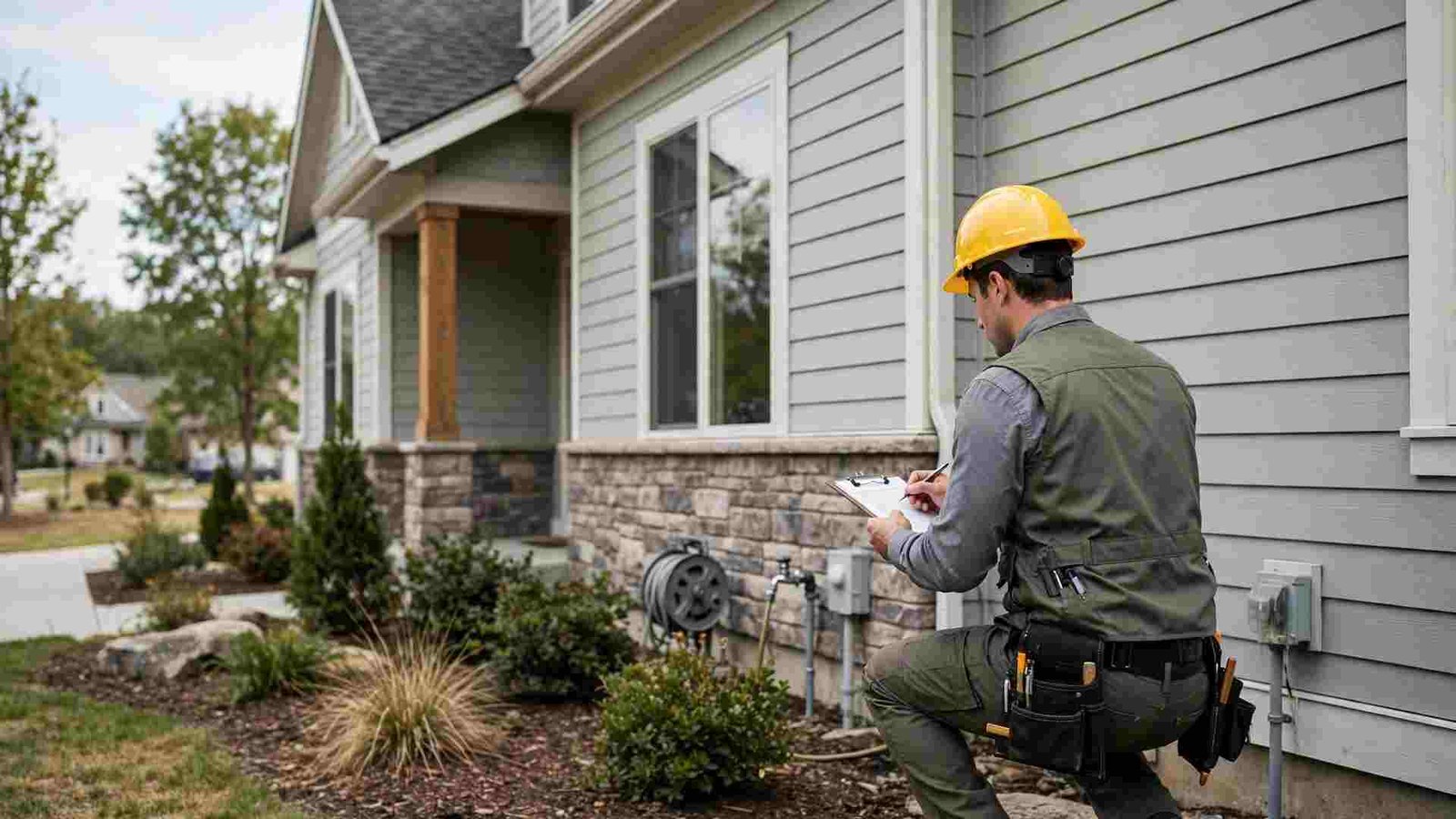
A home inspector’s job is to walk through a house before someone buys it and find every problem the buyer cannot see faulty wiring, a failing roof, a cracked foundation. It is detail-oriented, physical work that pays well and lets you run your own schedule.
The path is shorter than most skilled trades, but it varies sharply by state: some demand 200 hours of training plus a national exam, while others have no licensing law at all.
This guide lays out the full process, the costs, the exam, the insurance you need, and the business-building steps most competitors skip.
This article is general career information, not legal advice. Licensing rules change, so confirm current requirements with your state’s regulatory board.
Understand What A Home Inspector Actually Does
Before you spend a dollar on training, get the job itself right. A home inspector performs a visual, non-invasive examination of a residential property’s systems and components roof, exterior, structure, electrical, plumbing, HVAC, interior, insulation, and ventilation and delivers a written report to the client, usually the homebuyer. You do not tear open walls, move furniture, or fix what you find. Your product is the report: clear, accurate, and delivered fast, typically within 24 hours.
Most inspectors are self-employed, which means you are also a small business owner. Expect to climb ladders, crawl attics and crawlspaces, and carry 20 pounds of gear. A typical inspection takes two to four hours plus report-writing time, and fees commonly range from $300 to $600 depending on the market. Understanding this reality upfront saves you from discovering mid-training that the physical demands are not for you.
Pro tip: Write most of the report on-site, between systems, instead of photographing everything and writing at midnight. Inspectors who dictate findings into their phone and assemble the report in the driveway reliably hit the 24-hour turnaround agents love — and fast reports are what get you referred twice.
Check Your State’s Licensing Requirements First
This is the step that trips up more beginners than any other, because there is no national home inspector license. Roughly two-thirds of U.S. states license home inspectors; the rest either have no licensing law or are in transition. In licensed states you generally need to be at least 18, hold a high school diploma or GED, complete state-approved pre-licensing education (anywhere from 40 to 200 hours depending on the state), and pass the National Home Inspector Examination (NHIE).
In unlicensed states, anyone can legally offer inspections but that does not mean you should skip training. Real estate agents and buyers still look for credentials like InterNACHI or ASHI certification before referring work. Also watch states that recently added licensing: Utah’s Private Home Inspector license, created under House Bill 58, took effect January 1, 2026, requiring national certification plus $500,000 in general liability and $500,000 in errors and omissions coverage. Other states periodically revise their rules, so check your state’s real estate commission or department of professional licensing before you enroll in any course.
Complete Your Training And Education
Once you know your state’s hour requirement, choose a training provider approved by your state board. The major national providers InterNACHI, ICA (Inspection Certification Associates), AHIT, and ATI offer online and classroom courses, and InterNACHI’s pre-licensing program alone totals 149 hours of coursework covering structural systems, electrical, plumbing, HVAC, and report writing. Costs typically run $1,000 to $2,000 depending on the provider and format.
Online courses are legitimate and widely accepted, but do not treat them as passive watching. The NHIE tests applied knowledge, so pair coursework with hands-on practice: inspect friends’ and family members’ homes and practice writing full reports. Some states also require supervised field inspections alongside a licensed inspector build those mentor relationships early, because finding one can take weeks.
Pass The National Home Inspector Examination
The NHIE is the gatekeeper exam in most licensed states. It is a four-hour, computer-based test of 200 multiple-choice questions administered at Pearson VUE testing centers, costing around $225 per attempt. You need a scaled score of at least 500 out of 800 to pass. The exam covers the core knowledge domains of the profession: building science, inspection procedures, and the standards of practice that define what an inspector must and must not do.
Give yourself two to four weeks of dedicated study after finishing coursework, and take at least 700 practice questions under timed conditions. The exam’s difficulty catches people who only memorized definitions — it tests scenario judgment, like identifying the correct defect in a described electrical panel.
Common mistake: Studying the NHIE like a vocabulary quiz. The questions that sink first-timers are judgment calls — for example, whether a condition counts as a “material defect” needing immediate reporting or just a maintenance note. When you study, explain why each defect matters out loud; if you can’t, you don’t know it yet. A handful of states accept alternate exams, so confirm which test your state recognizes. If you fail, you can retake it, but each attempt costs another $225, so preparation pays.
Get Insured Before You Touch A House
Insurance is not an optional add-on; most states require it before issuing a license, and even in unlicensed states no serious agent will refer an uninsured inspector. You need two policies. General liability insurance protects you if you damage property or someone is injured during an inspection — coverage minimums often start at $100,000 to $300,000. Errors and omissions (E&O) insurance protects you if a client claims you missed a defect; some states require $300,000 to $500,000 in E&O coverage.
Budget roughly $1,000 to $2,500 per year for both policies combined as a new inspector, with E&O typically the larger share. Buy from an insurer that specializes in home inspector policies rather than a generic business insurer, because the policy language needs to match inspection work. Keep certificates of insurance ready — brokerages and real estate offices will ask for them before adding you to their referral lists.
Apply For Your License And Set Up Your Business
With training, exam results, insurance, and any field hours in hand, submit your license application to your state’s regulatory agency with the required fee (commonly $50 to $300) and proof of everything. Processing typically takes two to six weeks. Some states also require fingerprinting and a background check, so do not wait until the last minute.
In parallel, set up the business itself: register a business entity (most inspectors start as an LLC or sole proprietorship), get inspection report software, build a simple website with online scheduling, and order basic equipment — ladder, flashlight, moisture meter, electrical testers, respirator, and coveralls, roughly $1,500 to $3,000 to start. Price your inspections by researching local competitors; undercutting the market signals low quality in a trust-based business.
Land Your First Clients
Here is where most new inspectors stall, and where most guides go quiet. Your first 20 inspections will come from relationships, not advertising. Visit real estate offices with printed sample reports — agents refer inspectors they trust, and a professional sample report demonstrates competence better than any brochure. Offer to speak at first-time homebuyer seminars, join your local Realtor association as an affiliate member, and ask every satisfied client for a Google review.
One inspector I know got nearly half his first-year inspections from a single real estate office — by walking in with sample reports, a box of coffee, and a five-minute pitch about his same-day reports. It cost about $40. Agents refer inspectors they trust with their clients; being a familiar, reliable face beats paid advertising in year one.
Speed is a competitive weapon: deliver reports within 24 hours and answer your phone during business hours. Many inspectors also add ancillary services once established — radon testing, mold sampling, and sewer scopes — each adding $75 to $200 per job.
FAQs:
How long does it take to become a home inspector?
Most people complete the process in two to six months: a few weeks to a few months of coursework, two to four weeks of exam study, and two to six weeks of license application processing. States with high hour requirements or field-training mandates stretch toward the longer end.
How much does it cost to become a home inspector?
Expect $2,500 to $6,000 all-in: $1,000 to $2,000 for training, $225 for the NHIE, $50 to $300 in application and background fees, $1,000 to $2,500 per year for insurance, and $1,500 to $3,000 for equipment and business setup.
Do I need a college degree to become a home inspector?
No. A high school diploma or GED is the standard educational requirement. Construction, engineering, or trades experience helps, but plenty of successful inspectors come from unrelated careers.
Can I become a home inspector in a state with no licensing?
Yes in unlicensed states there is no legal barrier. Still, complete reputable training and earn a national certification (InterNACHI or ASHI) because buyers, agents, and insurers expect credentials.
Is the NHIE hard to pass?
It is challenging but fair. Candidates who complete quality training and do 700-plus timed practice questions generally pass on the first attempt. Rushing in underprepared is the main reason people fail.
How much do home inspectors make?
Earnings vary widely by market and volume. National averages cluster around $55,000 to $65,000 per year, with established inspectors doing 200-plus inspections annually earning well into six figures. Part-time inspectors earn proportionally less.
Conclusion:
Becoming a home inspector rewards diligence more than credentials: learn your state’s rules first, complete solid training, pass the NHIE, carry proper insurance, and work relentlessly at building agent relationships.
The inspectors who struggle are usually not the ones who failed the exam they are the ones who treated marketing as an afterthought.
Master both the technical and business sides, and you will have a career with genuine independence and income that scales with effort.

Hi, I’m Ethan Caldwell. I enjoy writing simple and creative similes. I help readers express feelings like love and happiness in easy words on Similisticez.com.