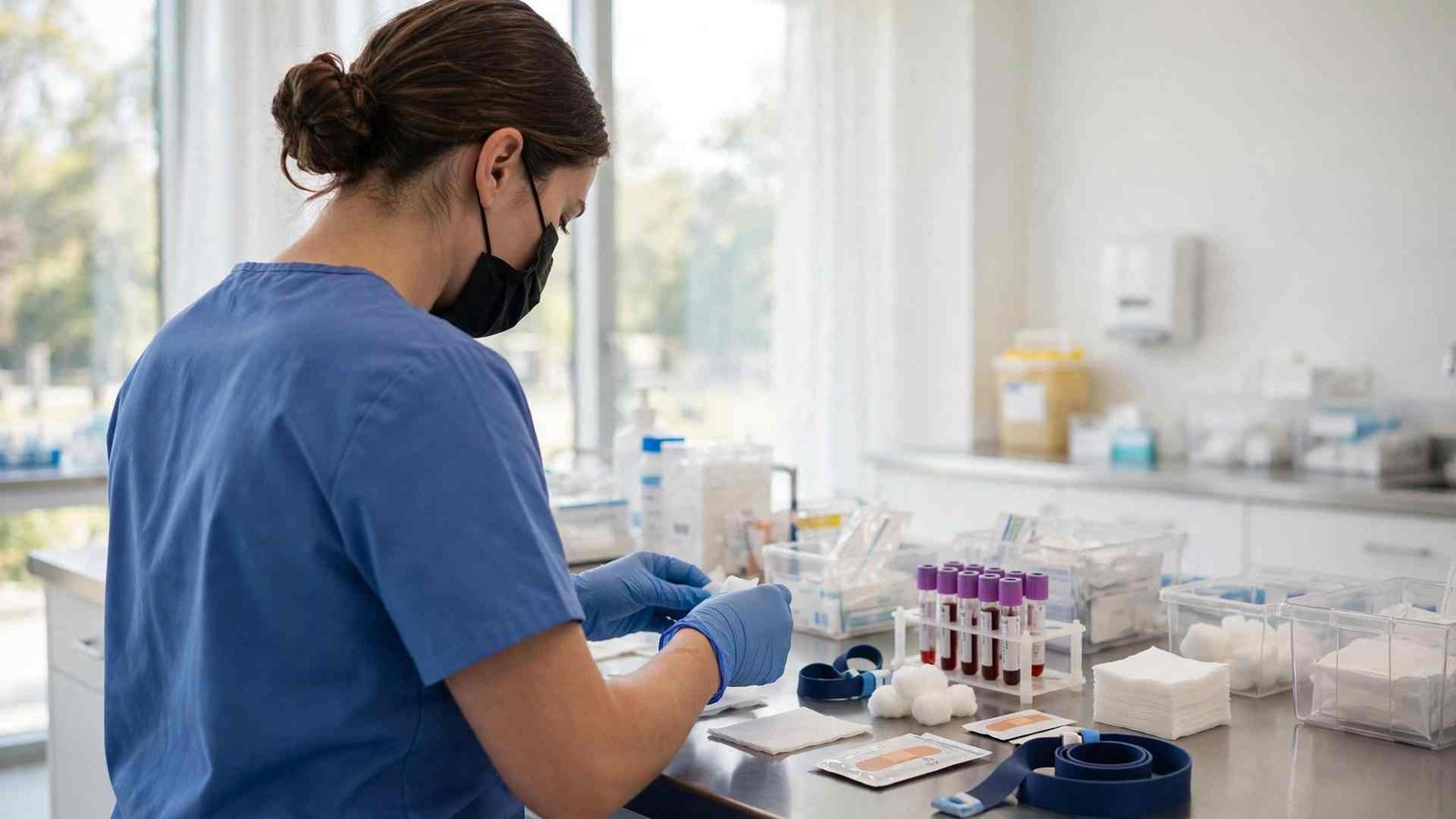
Phlebotomists are the healthcare workers who draw blood for tests, donations, and transfusions a role every hospital, clinic, and lab depends on daily.
It is one of the fastest on-ramps into healthcare: training takes weeks to months rather than years, the work is hands-on and patient-facing, and demand stays strong as the population ages.
But the path confuses beginners, because certification names overlap (CPT means different things at different agencies), a few states require actual licenses, and programs vary wildly in quality.
This guide untangles the whole process training, clinical hours, certification choices, state quirks, and job hunting including the details competitors gloss over.
This article is general career information, not medical or legal advice. Verify licensing rules with your state’s health department.
Confirm You Meet The Basic Requirements
Phlebotomy programs keep entry requirements simple: you must be at least 18 years old and hold a high school diploma or GED. Beyond that, programs and employers look for practical traits — steady hands, attention to detail, comfort around blood and needles (yours and others’), and the communication skills to calm nervous patients. Most employers also require a criminal background check, drug screening, and up-to-date immunizations including hepatitis B, since you will handle bloodborne pathogens daily.
If you are squeamish about needles or faint at the sight of blood, be honest with yourself now. This is a non-negotiable core of the job. Shadowing a working phlebotomist for a day — many will agree if you ask politely — is the fastest way to confirm the career fits before you spend money on training.
A phlebotomist I know almost quit in her first week of clinicals — her hands shook so badly on her first live draw that the patient asked if she was okay. By draw fifty she was steady. Shaky starts are normal and fixable; a genuine inability to be around blood is not. One honest day of shadowing answers the question before you’ve spent a dollar.
Choose An Accredited Training Program
Training programs are offered by community colleges, vocational schools, hospitals, and private providers, lasting anywhere from four weeks to several months. Costs typically range from $700 to $3,000 depending on the provider and length. Prioritize programs accredited by the National Accrediting Agency for Clinical Laboratory Sciences (NAACLS) or otherwise recognized by major certifying bodies — accreditation affects your certification eligibility and how employers view your credential.
A strong program covers venipuncture and capillary collection techniques, anatomy and physiology of the circulatory system, infection control and safety protocols, specimen handling and labeling, and patient interaction. The critical question to ask any school: how many successful blood draws will I perform, and where does the clinical externship take place? Programs that cannot answer clearly, or that offer little hands-on practice, should be crossed off your list. Classroom theory without real sticks does not produce employable phlebotomists.
Complete Your Clinical Hours And Externship
Hands-on clinical experience is where you become a phlebotomist rather than a student of phlebotomy. Most programs include a supervised externship in a hospital, clinic, or lab where you perform real blood draws on real patients. Certification bodies commonly expect around 100 successful venipunctures plus a set number of capillary sticks, though exact numbers vary by agency.
Treat your externship as a months-long job interview: show up early, volunteer for difficult draws, learn the lab’s labeling and transport protocols precisely, and build relationships with the staff. A large share of phlebotomy jobs go to externs who impressed their preceptors. If your program does not arrange an externship, you will need to find clinical hours independently — ask local hospitals, plasma donation centers, and mobile blood-drive organizations, which are often open to training motivated candidates.
Pro tip: Always ask the patient which arm usually works better — regular donors and hospital patients typically know their “good vein,” and asking builds instant trust while saving you missed sticks. And anchor the vein firmly with your non-dominant thumb below the insertion point on every draw; a rolling vein is the number-one reason beginners miss, and anchoring fixes most of it.
Pick The Right Certification For You
Here is the naming confusion, decoded. Four national bodies dominate phlebotomy certification, and several use the same “CPT” initials for different credentials:
- NHA Certified Phlebotomy Technician (CPT) from the National Healthcareer Association; requires an approved training program and passing the exam. Widely recognized by employers.
- ASCP Phlebotomy Technician (PBT) from the American Society for Clinical Pathology; requires accredited training plus clinical hours and a written exam. Highly respected, especially by hospitals.
- AMT Registered Phlebotomy Technician (RPT) from American Medical Technologists; accepts training plus clinical hours or qualifying work experience.
- NCCT National Certified Phlebotomy Technician (NCPT) from the National Center for Competency Testing; offers routes through training or experience.
Which should you choose? Check job postings in your area first many list a preferred credential, and matching it removes friction. If you plan to work in a hospital lab, the ASCP PBT carries particular weight. If you trained through an NHA-aligned school, the NHA CPT is the natural fit. There is no single “best” certification; there is the one your target employers ask for.
Know The States That Require A License
Most states do not license phlebotomists certification is voluntary but strongly preferred by employers. However, a handful of states do regulate the role, and the requirements are stricter. California requires a state phlebotomy license with specific training hours and a set number of supervised draws. Louisiana, Nevada, and Washington also have state-level requirements. If you live in one of these states, factor the state license into your timeline and budget from the start, because it adds steps beyond national certification.
Even in unregulated states, treat certification as effectively mandatory: job postings overwhelmingly prefer or require a national credential, and certified phlebotomists consistently earn more. Maintain your certification through continuing education most credentials renew every two to three years and keep your CPR certification current, which many employers require.
Get Hired And Grow Your Career
Start applying before your certification exam if your state allows it; many employers hire new graduates conditionally. Target hospitals, outpatient clinics, diagnostic laboratories, blood donation centers, and plasma centers donation centers in particular hire entry-level phlebotomists aggressively and provide excellent high-volume practice. Highlight your total successful draw count on your resume; hiring managers care about that number more than your GPA.
A friend of mine was hired straight out of her externship at a plasma center — not for the highest exam score, but because she’d volunteered for the anxious donors everyone else avoided and the staff noticed. Donation centers run high volume, which builds your draw count fast and produces frequent entry-level openings. If hospitals aren’t calling back, start there.
Once employed, phlebotomy opens doors: experienced phlebotomists advance to lead tech or supervisor roles, specialize in pediatric or geriatric draws, or use the role as a stepping stone into nursing, medical laboratory science, or physician assistant programs — with patient-care hours that strengthen those applications. The median pay for phlebotomists sits in the mid-$40,000s nationally, with hospital and specialty settings paying above outpatient clinics.
FAQs:
How long does it take to become a phlebotomist?
Training programs run four weeks to several months, plus study time for the certification exam. Most people go from enrollment to certified and job-ready in two to six months.
How much does phlebotomy training cost?
Typically $700 to $3,000 for the program, plus $100 to $250 in certification exam fees. Community colleges are usually the most affordable accredited option.
Do I need certification to work as a phlebotomist?
In most states certification is not legally required, but the vast majority of employers require or strongly prefer it. A few states (California, Louisiana, Nevada, Washington) have their own licensing requirements.
Which phlebotomy certification is best?
The NHA CPT, ASCP PBT, AMT RPT, and NCCT NCPT are all nationally recognized. Check which credential local employers list in job postings and match it — that matters more than any ranking.
Can I become a phlebotomist online?
The classroom portion can be done online, but you cannot skip hands-on clinical practice. Any legitimate path includes supervised blood draws on real patients through an externship or clinical placement.
Is phlebotomy a good stepping stone to nursing?
Yes. It provides paid patient-care experience, comfort with clinical procedures, and healthcare references all of which strengthen nursing, MLT, and PA school applications.
Conclusion:
Becoming a phlebotomist is one of the most efficient entries into healthcare: meet the basic requirements, complete an accredited program with real clinical hours, earn the national certification your local employers prefer, and satisfy any state licensing rules.
The differentiator between graduates who get hired fast and those who struggle is hands-on competence the number of successful draws you have performed and the professionalism you showed during your externship.
If you want meaningful patient-facing work without years of schooling, phlebotomy deserves a serious look. Research accredited programs near you and take the first step.

Hi, I’m Ethan Caldwell. I enjoy writing simple and creative similes. I help readers express feelings like love and happiness in easy words on Similisticez.com.