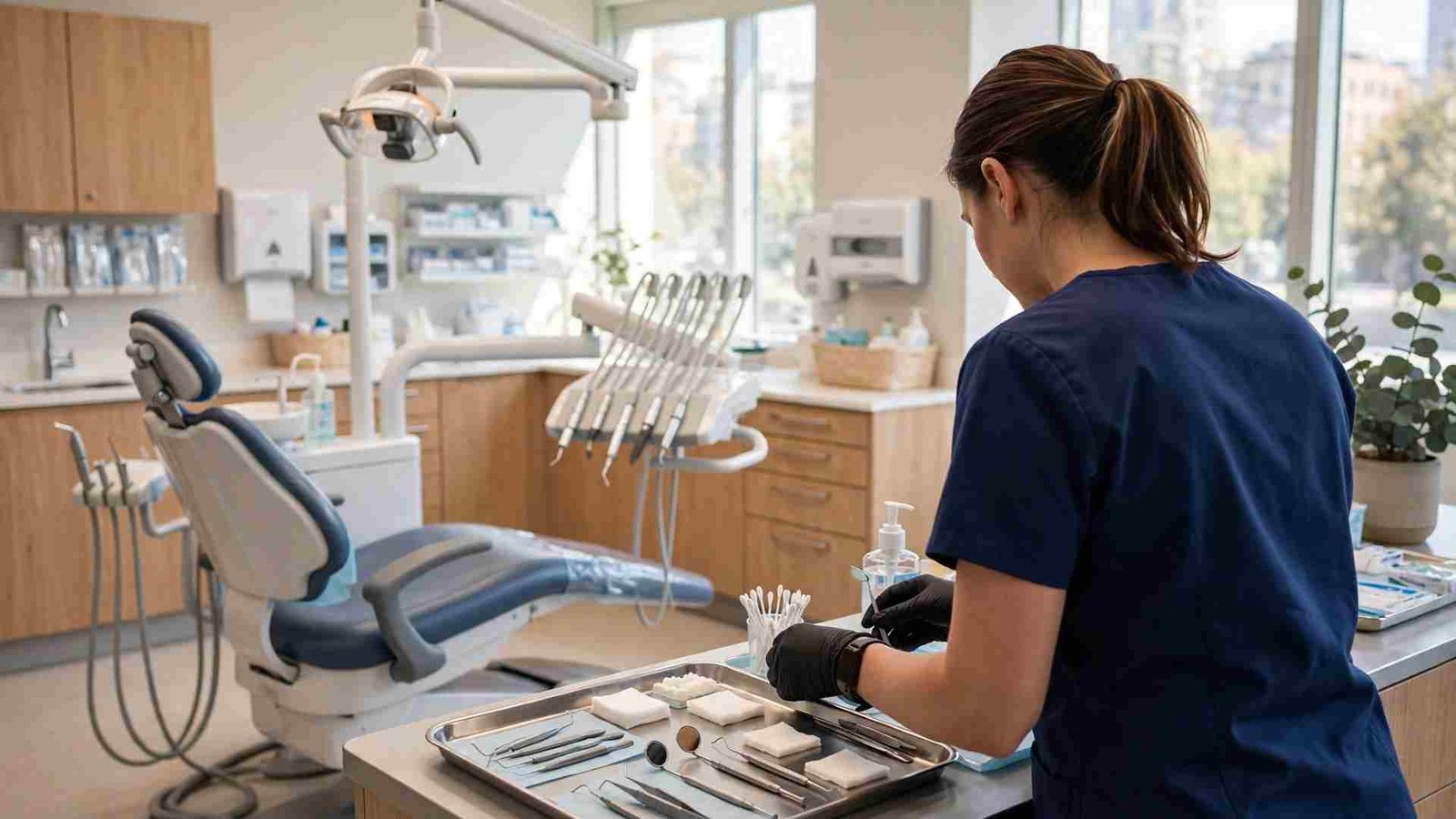
Dental assistants are the dentist’s right hand preparing patients, sterilizing instruments, taking X-rays, assisting chairside during procedures, and keeping the office running.
It is a stable, people-oriented healthcare career you can enter in under a year, often without a degree. But the path has a twist most guides underplay: in many states you can start with no formal training at all, while in others you need specific credentials before you can take an X-ray.
This guide maps every route formal programs, on-the-job training, and national certification plus the expanded-functions credentials and job strategies competitors rarely cover.
This article is general career information, not legal advice. Verify requirements with your state’s dental board.
Learn What Dental Assistants Actually Do
The day-to-day work blends clinical and administrative duties. Chairside, you will prepare treatment rooms, hand instruments to the dentist during procedures, suction and retract, take dental impressions, and ensure patient comfort. Behind the scenes, you sterilize instruments, take and process X-rays, maintain patient records, schedule appointments, and manage supplies. Specialties like orthodontics, oral surgery, and pediatric dentistry each add their own procedures and pace.
It is active, precise work that rewards organization, calm under pressure, and genuine comfort interacting with anxious patients. If you like healthcare but want a role with regular hours, no night shifts, and direct patient contact without the years of schooling nursing requires, dental assisting fits well.
Check Your State’s Rules Before Anything Else
Dental assisting is regulated state by state, and the spectrum is wide. On one end, states including Texas, Illinois, Hawaii, and Virginia allow you to work as a dental assistant with no formal training or certification, under a dentist’s supervision — on-the-job training is a fully legal entry route. On the other end, states like California and New York require registration, specific coursework (often in radiology and infection control), and sometimes state exams before you can perform certain duties.
The most common middle ground: you may work as a general dental assistant freely, but taking X-rays or performing expanded functions requires additional certification. Look up your state dental board’s published requirements for dental assistants specifically — not just the dentist licensing page and note exactly which duties trigger extra requirements. Choosing your path before checking this page is the classic beginner mistake.
Choose Your Training Path
You have three legitimate routes, and the right one depends on your state and budget:
Certificate or diploma programs (9-12 months). Offered by community colleges and vocational schools, these cover dental anatomy, radiology, infection control, chairside assisting, and dental materials, usually including an externship. Look for programs accredited by the Commission on Dental Accreditation (CODA) accreditation matters for certification eligibility and employer confidence. Costs typically run $3,000 to $15,000.
Associate degree programs (about 2 years). Add general education to the clinical training. Worth considering if you might later bridge into dental hygiene, which requires a degree and pays substantially more.
On-the-job training (several months). In states that allow it, you can get hired with only a high school diploma and learn chairside from the dentist and staff. This costs nothing but requires finding an office willing to train smaller private practices are your best bet. Formal training still improves your starting pay and mobility, so treat OJT as a starting point, not necessarily the ceiling.
Pro tip: When comparing programs, ask where recent graduates actually did their externships and whether the school places you or leaves you to find a site. The externship is where hiring happens; a program whose grads extern at busy multi-doctor practices beats a cheaper one whose students scramble for placements. One assistant I know was offered a job in week three of her externship at a practice that never posted the position.
Whichever route you take, get CPR certified early most employers and programs require it.
Earn National Certification Through DANB
The Certified Dental Assistant (CDA) credential from the Dental Assisting National Board (DANB) is the profession’s most recognized national certification. To qualify, you generally need a high school diploma plus graduation from a CODA-accredited program or qualifying work experience (around 3,500 hours). The CDA exam has three components: General Chairside Assisting (GC), Radiation Health and Safety (RHS), and Infection Control (ICE) — you must pass all three.
Common mistake: Walking into the RHS (radiation health and safety) exam having only memorized which buttons to push. The questions that trip candidates up are technique-judgment ones looking at a foreshortened image and knowing whether the vertical angulation was too steep or too shallow. If you can diagnose the positioning error behind a flawed X-ray, you’re ready.
Even where not legally required, the CDA measurably improves hiring prospects and pay, and it makes you portable across states. Some states also offer their own credentials, such as Registered Dental Assistant (RDA) status, with separate exams. Beyond the CDA, DANB offers specialty certifications (for example, in orthodontic assisting), and many states recognize Expanded Functions Dental Assistant (EFDA) credentials that legally allow you to place fillings, take final impressions, and perform other advanced tasks each expansion raising your value and pay.
Build Experience That Employers Want
Classroom knowledge gets you interviews; hands-on competence gets you hired. If your program includes an externship, treat it as an extended audition offices frequently hire externs who prove reliable. If you trained on the job, document every skill you master (radiology positioning, sealant placement where allowed, digital charting systems) so your resume reflects real capabilities, not just months employed.
Volunteering at community dental clinics or dental mission events adds both experience and references. Keep a simple log of procedures you have assisted with and any continuing education you complete DANB certification requires ongoing CE hours to maintain, and tracking them from the start keeps renewal painless.
Get Hired And Advance Your Career
Apply broadly: general practices, orthodontic and oral surgery specialty offices, pediatric dentistry, community health clinics, and dental schools all hire assistants, and specialty practices often pay premiums. On your resume, lead with certifications, radiology credentials, externship hours, and software familiarity (Dentrix, Eaglesoft, and similar practice-management systems appear in job postings constantly). In interviews, emphasize reliability, infection-control discipline, and patient communication the three things dentists say they value most.
Bring a one-page skills checklist to interviews radiology credential, sealants, coronal polishing where your state allows, the charting systems you’ve used. Most candidates arrive with a generic resume; the one who hands the dentist a concrete list of what she can legally do on day one stands out immediately. And send a short thank-you note afterward — dental offices are small teams, and courtesy registers.
Starting pay for dental assistants typically lands in the mid-$40,000s nationally, rising with certification, expanded functions, and specialty settings. Long-term paths include EFDA credentials, office management, dental sales, or bridging into dental hygiene school — a common and lucrative next step that your assisting experience will make far easier.
FAQs:
How long does it take to become a dental assistant?
Certificate programs take 9 to 12 months; associate degrees take about two years. In states allowing on-the-job training, you can start working in weeks and build skills over several months.
How much does dental assistant training cost?
Certificate programs typically cost $3,000 to $15,000 at community colleges and vocational schools. On-the-job training costs nothing but your time, though formal training usually leads to higher starting pay.
Can I become a dental assistant with no experience?
Yes, in many states. States like Texas, Illinois, and Virginia allow dental assistants to train on the job under a dentist’s supervision with no prior certification. Check your state dental board first.
What is the DANB CDA exam like?
The Certified Dental Assistant exam has three parts — General Chairside Assisting, Radiation Health and Safety, and Infection Control — and you must pass all three. Most candidates prepare with review courses and practice exams after completing an accredited program.
Do dental assistants take X-rays?
Often, but radiology duties are the most commonly restricted task: many states require a separate radiology certification or coursework before you can legally take X-rays. Confirm your state’s rule before assuming.
What is an expanded functions dental assistant?
An EFDA completes additional training and certification allowing advanced clinical duties such as placing restorative materials or taking final impressions that general assistants cannot legally perform. It typically comes with higher pay.
Conclusion:
Dental assisting offers a genuinely accessible healthcare career: check your state board’s requirements, choose between a CODA accredited program and on the job training, earn DANB certification to maximize your options, and build hands on experience that employers can see.
The assistants who advance fastest are the ones who keep stacking credentials radiology, infection control, expanded functions while building a reputation for reliability chairside.
If you want patient facing healthcare work with regular hours and a clear growth ladder, start by looking up your state’s dental assistant requirements today.

Hi, I’m Ethan Caldwell. I enjoy writing simple and creative similes. I help readers express feelings like love and happiness in easy words on Similisticez.com.