English Class Is Like…? 25 Fun Similes to Finish the Sentence (With Meanings)
If you typed “finish the simile: English class is like” into Google, you are probably staring at a worksheet or a homework prompt and wondering what to write next. You are not alone. Thousands of students search this exact phrase every month, and teachers hand out finish-the-simile exercises because they are one of the fastest ways to build descriptive writing skills.
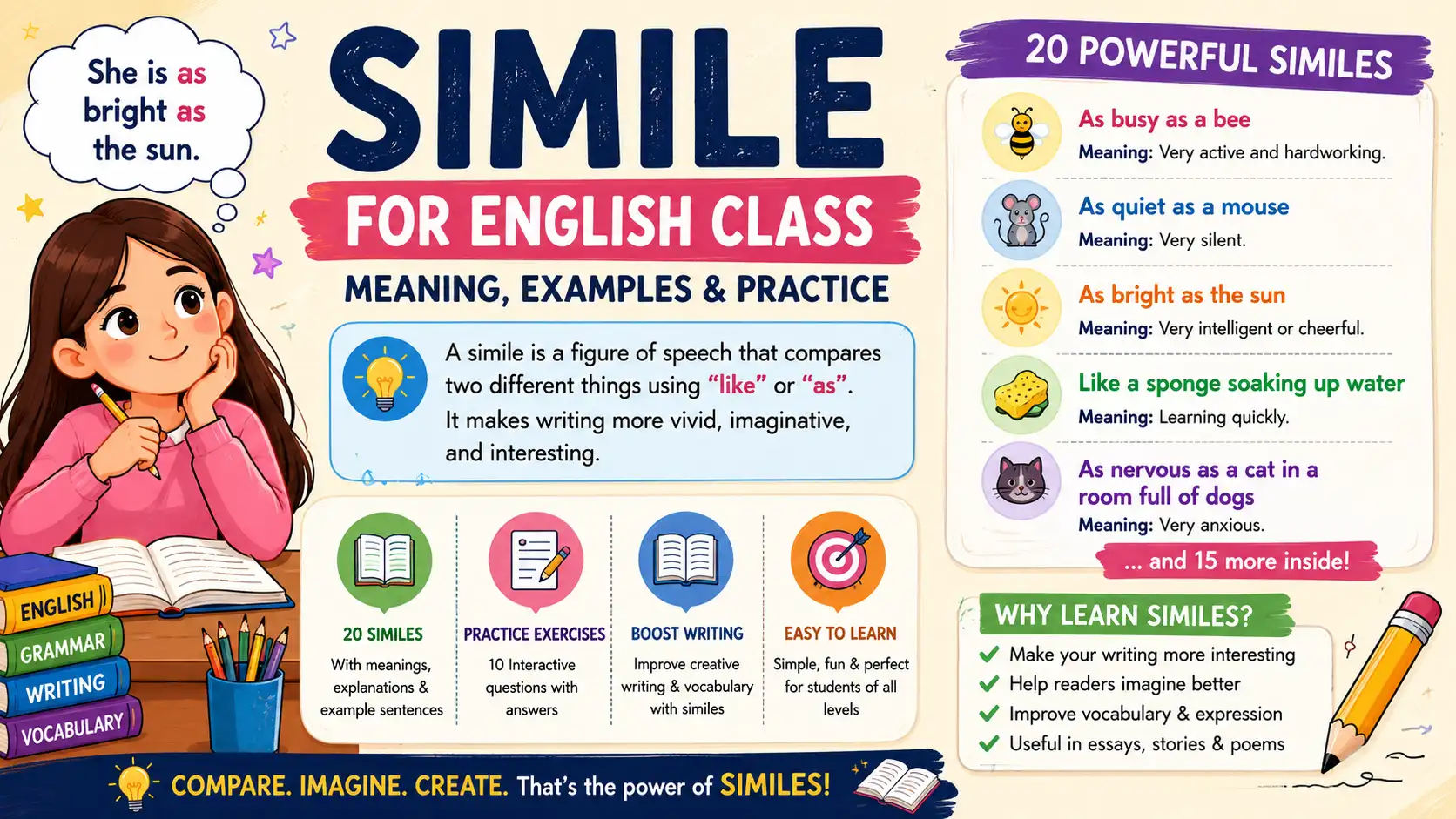
A simile is a comparison between two different things using the words “like” or “as”. When your teacher asks you to finish “English class is like…”, the job is simple: compare English class to something vivid, unexpected, or funny, and make the comparison clear enough that a reader pictures it instantly.
In this guide you will find 25 fresh similes grouped by mood, each with a clear meaning and an example sentence you can borrow or adapt. You will also learn a simple four-step method for finishing any simile on your own, plus a practice quiz with answers. By the end, you will never get stuck on a finish-the-simile prompt again.
What Does “Finish the Simile” Mean?
A simile starter gives you the first half of a comparison, such as “English class is like…”, and your job is to complete it with a creative ending. The best completions do three things: they use “like” or “as”, they connect two very different things, and they paint a picture the reader can see immediately.
For example, “English class is like a treasure hunt through the dictionary” works because it compares lessons to an adventure, and the reader instantly understands the feeling of discovering new words. A weak completion, such as “English class is like a class”, compares nothing new and teaches the reader nothing. The magic is in the surprise.
25 Similes That Finish “English Class Is Like”
Below are 25 classroom-ready similes organized by mood. Pick the ones that match how you honestly feel, or mix and match to create your own.
Funny Similes
1. English class is like a box of surprises.
Meaning: Every lesson brings something unexpected, from new stories to surprise quizzes.
Example: English class is like a box of surprises because we never know whether we will read poetry or take a pop quiz.
2. English class is like trying to drink from a fire hose.
Meaning: New information arrives so fast that it feels impossible to absorb it all.
Example: During exam week, English class is like trying to drink from a fire hose with all the vocabulary lists pouring in.
3. English class is like a roller coaster for your brain.
Meaning: The lesson swings quickly between excitement, confusion, and sudden understanding.
Example: One minute we are laughing at a funny story, and the next we are diagramming sentences, so English class is like a roller coaster for your brain.
4. English class is like herding cats during group work.
Meaning: Getting every group member to focus and cooperate feels nearly impossible.
Example: Our literature project felt chaotic because English class is like herding cats during group work.
5. English class is like watching paint dry during grammar drills.
Meaning: Repetitive grammar exercises can feel extremely slow and dull.
Example: The third worksheet on commas made the afternoon feel endless, as if English class is like watching paint dry during grammar drills.
6. English class is like a comedy show when the teacher reads aloud.
Meaning: A teacher with dramatic voices and funny timing can turn reading into entertainment.
Example: When Mrs. Alvarez acts out the characters, English class is like a comedy show and nobody wants the bell to ring.
7. English class is like autocorrect for your brain.
Meaning: The lessons quietly fix your spelling, grammar, and word choices over time.
Example: I used to mix up similar words, but now English class is like autocorrect for my brain and I catch my own mistakes.
Similes About Challenge
8. English class is like climbing a mountain of essays.
Meaning: The workload feels steep and exhausting, but reaching the top brings real pride.
Example: With three papers due in one week, English class is like climbing a mountain of essays.
9. English class is like solving a puzzle with missing pieces.
Meaning: Understanding a difficult poem or play can feel confusing until the pieces finally click.
Example: Shakespeare made no sense at first, so English class is like solving a puzzle with missing pieces.
10. English class is like running a marathon with a heavy backpack.
Meaning: Long reading assignments make the whole term feel like an endurance test.
Example: Carrying a thick novel everywhere made English class feel like running a marathon with a heavy backpack.
11. English class is like trying to catch smoke.
Meaning: Some grammar rules and meanings feel slippery and hard to hold onto.
Example: I memorized the rule last night, but today it vanished, as if English class is like trying to catch smoke.
12. English class is like decoding a secret message.
Meaning: Old texts and hidden meanings in stories feel like codes waiting to be cracked.
Example: Reading between the lines of the short story made English class feel like decoding a secret message.
13. English class is like swimming against the current.
Meaning: A difficult novel can feel like a struggle where every page pushes back.
Example: The first fifty pages were so dense that English class felt like swimming against the current.
Inspiring Similes
14. English class is like opening a window to new worlds.
Meaning: Books and stories let you visit places, times, and lives you may never see otherwise.
Example: Through novels set on other continents, English class is like opening a window to new worlds.
15. English class is like planting seeds that grow into ideas.
Meaning: Small lessons today grow into strong thinking and writing skills later.
Example: The vocabulary we learned in September is blooming now, so English class is like planting seeds that grow into ideas.
16. English class is like a key that unlocks new stories.
Meaning: Reading skills open doors to every book, article, and story you will ever meet.
Example: Once I learned to read critically, English class felt like a key that unlocks new stories everywhere.
17. English class is like a bridge between cultures.
Meaning: Literature connects you with people from different backgrounds and centuries.
Example: Reading folktales from around the world showed me that English class is like a bridge between cultures.
18. English class is like a flashlight in a dark room.
Meaning: A good teacher shines light on confusing topics until everything becomes clear.
Example: Her explanation of theme and tone was so clear that English class felt like a flashlight in a dark room.
19. English class is like a gym workout for your imagination.
Meaning: Creative writing exercises stretch and strengthen your imagination the way exercise builds muscle.
Example: Daily journal prompts made my ideas stronger, as if English class is like a gym workout for your imagination.
Calm and Cozy Similes
20. English class is like a warm cup of cocoa on a rainy day.
Meaning: Quiet reading time feels comforting, safe, and deeply relaxing.
Example: Silent reading period is my favorite because English class is like a warm cup of cocoa on a rainy day.
21. English class is like a quiet library full of friends.
Meaning: The classroom feels peaceful yet warm, surrounded by familiar faces and books.
Example: Everyone reading together in comfortable silence made English class feel like a quiet library full of friends.
22. English class is like a gentle stream of stories.
Meaning: Narratives flow smoothly one after another, carrying you along without effort.
Example: The storytelling unit moved so pleasantly that English class felt like a gentle stream of stories.
23. English class is like a soft blanket of words.
Meaning: Beautiful language wraps around you and makes you feel calm and cared for.
Example: Listening to poetry read aloud felt soothing, as if English class is like a soft blanket of words.
24. English class is like sitting by a fireplace with a good book.
Meaning: Deep reading brings the same warmth and contentment as a cozy evening indoors.
Example: Losing myself in the novel during study hall made English class feel like sitting by a fireplace with a good book.
25. English class is like a garden where ideas bloom.
Meaning: Discussions and writing activities help thoughts grow, spread, and blossom.
Example: Every debate planted something new in my mind, so English class is like a garden where ideas bloom.
How to Finish Any Simile in 4 Easy Steps
Step 1: Name the feeling. Decide what English class feels like to you right now. Is it exciting, boring, challenging, comforting, or confusing? Your honest feeling is the starting point.
Step 2: Think of something completely different. Brainstorm objects, animals, places, or activities that share that feeling. Boring might remind you of watching paint dry. Exciting might remind you of a roller coaster.
Step 3: Connect them with “like” or “as”. Place your comparison right after the starter phrase. For example: “English class is like a roller coaster for your brain.”
Step 4: Add the “why” in one sentence. A short explanation makes your simile stronger and shows the teacher you understand the comparison. Example: “It climbs slowly through grammar, then drops suddenly into creative writing.”
Practice Quiz: Can You Finish the Simile?
Test yourself with these quick prompts. Answers follow below.
1. English class is like a box of ______.
2. Which simile describes a boring grammar lesson: “like watching paint dry” or “like a flashlight in a dark room”?
3. English class is like ______ a mountain of essays.
4. Which simile fits a confusing poem: “like decoding a secret message” or “like a warm cup of cocoa”?
5. English class is like a ______ workout for your imagination.
6. Complete the simile: English class is like herding ______ during group work.
7. Which simile describes quiet reading time: “like a quiet library full of friends” or “like trying to drink from a fire hose”?
8. English class is like a ______ where ideas bloom.
Answers:
1. Surprises, because every lesson brings something unexpected.
2. “Like watching paint dry” describes a slow, dull lesson.
3. Climbing, which shows the workload feels steep.
4. “Like decoding a secret message” fits hidden meanings in poetry.
5. Gym, because creative exercises strengthen imagination.
6. Cats, since getting a group to focus feels nearly impossible.
7. “Like a quiet library full of friends” describes peaceful reading.
8. Garden, where discussions help ideas grow.
If you typed finish the simile: English class is like into a search box, you are probably staring at a worksheet or homework prompt. The good news is that this is one of the easiest creative writing tasks in school. A simile starter hands you the first half of a comparison, such as English class is like, and your job is to complete it with a creative ending.
The best completions do three things: they use like or as, they connect two very different things, and they paint a picture the reader can see at once. For example, English class is like a treasure hunt through the dictionary works because it compares lessons to an adventure. A weak ending, such as English class is like a class, compares nothing new and teaches the reader nothing. The magic is in the surprise.
Below you will find 30 classroom-ready similes organized by mood, each with a meaning and an example sentence. You will also get a simple four step method, tips for teachers, and a practice quiz with answers.
What Does Finish the Simile Mean?
To finish the simile means to complete a half-written comparison. The worksheet gives you a starter phrase with like or as already in place, and you supply the ending. English class is like a roller coaster for your brain is a finished simile. English class is like with nothing after it is an unfinished one. These exercises train vocabulary, creative thinking, and descriptive writing at the same time, which is why teachers assign them so often.
30 Similes That Finish English Class Is Like
Below are 30 similes organized by mood. Choose the ones that match your honest feeling, or combine ideas to invent your own.
Funny Similes
1. English class is like a box of surprises. Meaning: Every lesson brings something unexpected, from stories to pop quizzes. Example: English class is like a box of surprises because we never know whether we will read poetry or take a quiz.
2. English class is like trying to drink from a fire hose. Meaning: New information arrives so fast it feels impossible to absorb it all. Example: During exam week, English class is like trying to drink from a fire hose of vocabulary lists.
3. English class is like a roller coaster for your brain. Meaning: The lesson swings between excitement, confusion, and sudden understanding. Example: One minute we laugh at a story, the next we diagram sentences, so English class is like a roller coaster for your brain.
4. English class is like herding cats during group work. Meaning: Getting every group member to focus feels nearly impossible. Example: Our literature project was chaos because English class is like herding cats during group work.
5. English class is like watching paint dry during grammar drills. Meaning: Repetitive grammar exercises can feel extremely slow and dull. Example: The third worksheet on commas made English class feel like watching paint dry.
6. English class is like a comedy show when the teacher reads aloud. Meaning: A teacher with funny voices can turn reading into entertainment. Example: When the teacher acts out the characters, English class is like a comedy show.
7. English class is like autocorrect for your brain. Meaning: Lessons quietly fix your spelling and grammar over time. Example: I used to mix up similar words, but now English class is like autocorrect for my brain.
8. English class is like a detective show where the clues are commas. Meaning: Close reading feels like solving a mystery with punctuation as evidence. Example: Hunting the misplaced modifier made English class feel like a detective show where the clues are commas.
Similes About Challenge and Hard Work
9. English class is like climbing a mountain of essays. Meaning: The workload feels steep, but reaching the top brings real pride. Example: With three papers due in one week, English class is like climbing a mountain of essays.
10. English class is like solving a puzzle with missing pieces. Meaning: A difficult poem feels confusing until the pieces finally click. Example: Shakespeare made no sense at first, so English class is like solving a puzzle with missing pieces.
11. English class is like running a marathon with a heavy backpack. Meaning: Long reading assignments make the term feel like an endurance test. Example: Carrying a thick novel everywhere made English class feel like running a marathon with a heavy backpack.
12. English class is like trying to catch smoke. Meaning: Some grammar rules feel slippery and hard to hold on to. Example: I memorized the rule last night, but today it vanished, as if English class is like trying to catch smoke.
13. English class is like decoding a secret message. Meaning: Hidden meanings in stories feel like codes waiting to be cracked. Example: Reading between the lines made English class feel like decoding a secret message.
14. English class is like swimming against the current. Meaning: A dense novel feels like a struggle where every page pushes back. Example: The first fifty pages were so dense that English class felt like swimming against the current.
15. English class is like untangling earbuds pulled from a pocket. Meaning: A knotted sentence takes patience to sort out strand by strand. Example: The long sentence made English class feel like untangling earbuds pulled from a pocket.
16. English class is like climbing a ladder made of spelling words. Meaning: Each new word you master lifts you one rung higher. Example: The weekly spelling lists turned English class into climbing a ladder made of spelling words.
Inspiring Similes
17. English class is like opening a window to new worlds. Meaning: Books let you visit places, times, and lives you may never see otherwise. Example: Through novels set on other continents, English class is like opening a window to new worlds.
18. English class is like planting seeds that grow into ideas. Meaning: Small lessons today grow into strong thinking skills later. Example: The vocabulary from September is blooming now, so English class is like planting seeds that grow into ideas.
19. English class is like a key that unlocks new stories. Meaning: Reading skills open doors to every book you will ever meet. Example: Once I learned to read critically, English class felt like a key that unlocks new stories.
20. English class is like a bridge between cultures. Meaning: Literature connects you with people from different backgrounds and centuries. Example: Reading folktales from around the world showed me English class is like a bridge between cultures.
21. English class is like a flashlight in a dark room. Meaning: A good teacher shines light on confusing topics until all is clear. Example: Her explanation of theme was so clear that English class felt like a flashlight in a dark room.
22. English class is like a gym workout for your imagination. Meaning: Creative writing stretches your imagination the way exercise builds muscle. Example: Daily journal prompts made English class feel like a gym workout for my imagination.
23. English class is like a passport stamped with stories. Meaning: Every book you finish proves a journey your mind has taken. Example: By June my reading log made English class feel like a passport stamped with stories.
24. English class is like a toolbox for every future job. Meaning: Writing and speaking skills are tools you will carry into any career. Example: Learning to argue clearly showed me English class is like a toolbox for every future job.
Calm and Cozy Similes
25. English class is like a warm cup of cocoa on a rainy day. Meaning: Quiet reading time feels comforting, safe, and deeply relaxing. Example: Silent reading period is my favorite because English class is like a warm cup of cocoa on a rainy day.
26. English class is like a quiet library full of friends. Meaning: The classroom feels peaceful yet warm, full of familiar faces and books. Example: Everyone reading in comfortable silence made English class feel like a quiet library full of friends.
27. English class is like a gentle stream of stories. Meaning: Narratives flow smoothly one after another, carrying you along. Example: The storytelling unit moved so pleasantly that English class felt like a gentle stream of stories.
28. English class is like a soft blanket of words. Meaning: Beautiful language wraps around you and brings calm. Example: Listening to poetry read aloud felt like English class is a soft blanket of words.
29. English class is like sitting by a fireplace with a good book. Meaning: Deep reading brings the warmth of a cozy evening indoors. Example: Losing myself in the novel made English class feel like sitting by a fireplace with a good book.
30. English class is like a porch swing for your thoughts. Meaning: Discussion time lets ideas rock gently until they settle into place. Example: The slow Friday debate made English class feel like a porch swing for your thoughts.
How to Finish Any Simile in 4 Easy Steps
Step 1: Name the feeling. Decide what English class feels like right now. Exciting, boring, challenging, comforting, or confusing? Your honest feeling is the starting point.
Step 2: Think of something completely different. Brainstorm objects, animals, places, or activities that share that feeling. Boring might remind you of watching paint dry. Exciting might remind you of a roller coaster.
Step 3: Connect them with like or as. Place your comparison right after the starter phrase, for example: English class is like a roller coaster for your brain.
Step 4: Add the why in one sentence. A short explanation shows the teacher you understand the comparison. Example: It climbs slowly through grammar, then drops suddenly into creative writing.
Teacher Tips: Using Finish the Simile in Class
- Start with a shared starter. Write English class is like on the board and collect endings from every student.
- Sort by mood. Group similes into funny, challenging, inspiring, and calm. This turns one exercise into a lesson on tone.
- Require the why. Ask each student to add one sentence showing how the two sides connect.
- Build a class wall. Post the best finished similes on a bulletin board as a revision resource.
- Turn it into a quiz. Use the practice quiz below as a five minute warm up.
Practice Quiz: Can You Finish the Simile?
Test yourself with these quick prompts. Answers follow below.
- English class is like a box of ______.
- Which simile describes a boring grammar lesson: like watching paint dry or like a flashlight in a dark room?
- English class is like ______ a mountain of essays.
- Which simile fits a confusing poem: like decoding a secret message or like a warm cup of cocoa?
- English class is like a ______ workout for your imagination.
- Complete the simile: English class is like herding ______ during group work.
- Which simile describes quiet reading time: like a quiet library full of friends or like trying to drink from a fire hose?
- English class is like a ______ stamped with stories.
Answers: 1. Surprises. 2. Like watching paint dry. 3. Climbing. 4. Like decoding a secret message. 5. Gym. 6. Cats. 7. Like a quiet library full of friends. 8. Passport.
How to Write Your Own Similes for English Class
You do not need to borrow every line. A fresh simile is easy to build when you follow a simple pattern.
Step 1: Name the feeling or quality. Decide exactly what you want the reader to feel or notice, in one plain word.
Step 2: Find a familiar picture. Think of an everyday object, animal, or moment that carries the same quality in an obvious way.
Step 3: Connect the two. Join your subject and your picture with like or as, then read the sentence aloud to check that the picture is clear.
Step 4: Trim the extra words. A simile works best when it is short. Cut anything that explains the comparison twice.
Frequently Asked Questions
What is the best way to finish “English class is like”?
The best endings are specific and visual. Instead of a plain ending such as “English class is like school”, choose a vivid picture such as “English class is like a treasure hunt through the dictionary”, then add one sentence explaining the connection. Teachers reward originality and clear reasoning.
Can I use funny similes in school assignments?
Yes, as long as they are respectful and support your point. A funny simile such as “English class is like herding cats during group work” shows creativity and personality. Avoid jokes that mock your teacher or classmates, and keep the tone friendly.
What is the difference between a simile and a metaphor?
A simile uses “like” or “as” to make a comparison, for example “English class is like a garden”. A metaphor compares directly without those words, for example “English class is a garden”. Both are useful, but finish-the-simile exercises specifically require “like” or “as”.
How long should a finished simile be?
One strong sentence is usually enough, followed by a short explanation if your teacher asks for one. For example: “English class is like opening a window to new worlds, because every book shows me a life I have never lived.” Clear and complete beats long and rambling.
Why do teachers assign “finish the simile” exercises?
These exercises train three skills at once: vocabulary, because you search for precise words; creative thinking, because you connect unrelated ideas; and descriptive writing, because you paint pictures with words. They also make lessons more fun than plain definition drills.
Can I invent my own simile endings?
Absolutely, and you should. Look around your classroom for inspiration: the clock, the bookshelf, the chatter before the bell. Compare English class to anything you notice, then ask yourself why the comparison fits. Your own original similes will always stand out more than copied ones.
Similes for English Class for Reluctant Readers
Some students groan when English class starts. A funny or honest simile can break the ice and show them that reading is not a chore. Use these to open a lesson with a smile.
- English class is like a gym for your imagination: English class is like a gym for your imagination, and every story is a new workout.
- English class is like a treasure hunt in words: English class is like a treasure hunt in words, where every chapter hides something worth finding.
- English class is like a movie you read instead of watch: English class is like a movie you read instead of watch, and your mind directs every scene.
- English class is like a toolbox full of voices: English class is like a toolbox full of voices, and each book hands you a new one.
- English class is like a passport to other lives: English class is like a passport to other lives, stamped by every character you meet.
Similes for English Class in Exam Answers
Exam answers reward clear, confident comparisons. A well chosen simile can show understanding in one line, but it must stay on topic. Keep the image simple and link it back to the point you are making.
- English class is like a map for reading: English class is like a map for reading, because it teaches you how to find meaning in any text.
- English class is like a bridge between ideas: English class is like a bridge between ideas, joining what a writer says to what a reader feels.
- English class is like a mirror for the mind: English class is like a mirror for the mind, showing students how their own thinking works.
- English class is like a key to locked stories: English class is like a key to locked stories, opening plots that first seemed hard to follow.
- English class is like a garden where words grow: English class is like a garden where words grow, and careful reading helps each idea take root.
Similes for English Class Discussions
Class discussions come alive when students compare ideas to things they know, and similes give quiet students a safe way into the talk. These lines suit group work, presentations, and class journals.
- The poem opened like a door into a house we had never visited.
- Her argument flowed like a river finding its way around stones.
- The story felt long like a road trip with no map and good songs.
- His question landed like a stone in a pond during silent reading.
- The essay structure stood firm like shelves holding heavy books.
- Our discussion grew like a garden after a week of steady rain.
Invite students to build one simile for the text under discussion, then ask what the comparison reveals and what it hides.
Similes for English Class Exam Answers
Exam answers reward clarity, and a well chosen simile can show understanding faster than a paragraph of summary. Use one simile to open an analysis, then support it with evidence from the text.
- The character changed like a seed breaking open under dark soil.
- The theme ran through the novel like a thread in a winter coat.
- The narrator sounded distant like a voice from another room.
- The ending felt sudden like a light switched off mid sentence.
- The imagery worked like paint on a wall, layer after layer.
- The conflict burned slow like a candle in a draughty hall.
In exams, never let a simile replace evidence, so follow every comparison with a short quotation or a concrete detail from the text.
Similes for English Class as a Workshop
Thinking of English class as a workshop helps students see writing as craft, not magic. In a workshop, tools matter, practice matters, and messy first drafts are expected. A simile for this view should use workbench images, such as sanding a rough sentence smooth, sharpening a dull paragraph, or trying a new tool on scrap material first. These comparisons encourage revision, because they treat a weak draft as material to improve, not as failure. Students who see class as a workshop are more willing to rewrite, share work, and learn from feedback.
- English class is like sanding a rough sentence smooth. Meaning: revision slowly removes rough edges from writing. Example: Editing felt like sanding a rough sentence smooth, one pass at a time.
- English class is like sharpening a dull paragraph. Meaning: focused work makes ideas clearer and stronger. Example: The rewrite worked like sharpening a dull paragraph until the point shone.
- English class is like trying a new tool on scrap material first. Meaning: safe practice before using a skill in final work. Example: The exercise felt like trying a new tool on scrap material first.
- English class is like a workbench covered in drafts. Meaning: learning visible in layers of trial and improvement. Example: The term felt like a workbench covered in drafts, each one better than the last.
Similes for English Class as a Journey Through Books
Another useful view treats English class as a journey through books, where each text is a place visited and each discussion is a stop along the way. This view suits students who love stories and travel. Images of a train stopping at small stations, a map marked with favourite chapters, or a backpack filled with borrowed voices can show how reading changes a reader over a term. The journey simile also reminds students that confusion is normal at the start of a new book, just as a new town feels strange on arrival.
- English class is like a train stopping at small stations. Meaning: each book offers a brief, memorable visit. Example: The term moved like a train stopping at small stations, each novel a new place.
- English class is like a map marked with favourite chapters. Meaning: reading leaves a personal trail to revisit. Example: Her notebook read like a map marked with favourite chapters.
- English class is like a backpack filled with borrowed voices. Meaning: stories lend students new ways to speak and think. Example: He left class like a backpack filled with borrowed voices.
Frequently Asked Questions About English Class Similes
How do you finish English class is like in an exam
Name a feeling, pick a vivid comparison, then add one sentence explaining why it fits. A clear explanation earns more marks than a clever image alone.
Can English class similes be about hard work
Yes. Workshop images, such as sanding or sharpening, show effort and revision in a positive and honest way.
What makes a finish the simile answer stand out
Originality plus a clear link. A specific image tied to the lesson, such as a workbench or a train station, beats a generic comparison.
Conclusion
Finishing the simile “English class is like…” is easier than it looks once you have a method. Name the feeling, find an unexpected comparison, connect it with “like” or “as”, and explain the link in one sentence.
So grab a notebook and try five original endings today. Compare English class to your favorite food, your pet, the weather, or anything else that pops into your head. The more you practice, the faster vivid comparisons will come, and your writing will become more colorful with every assignment.