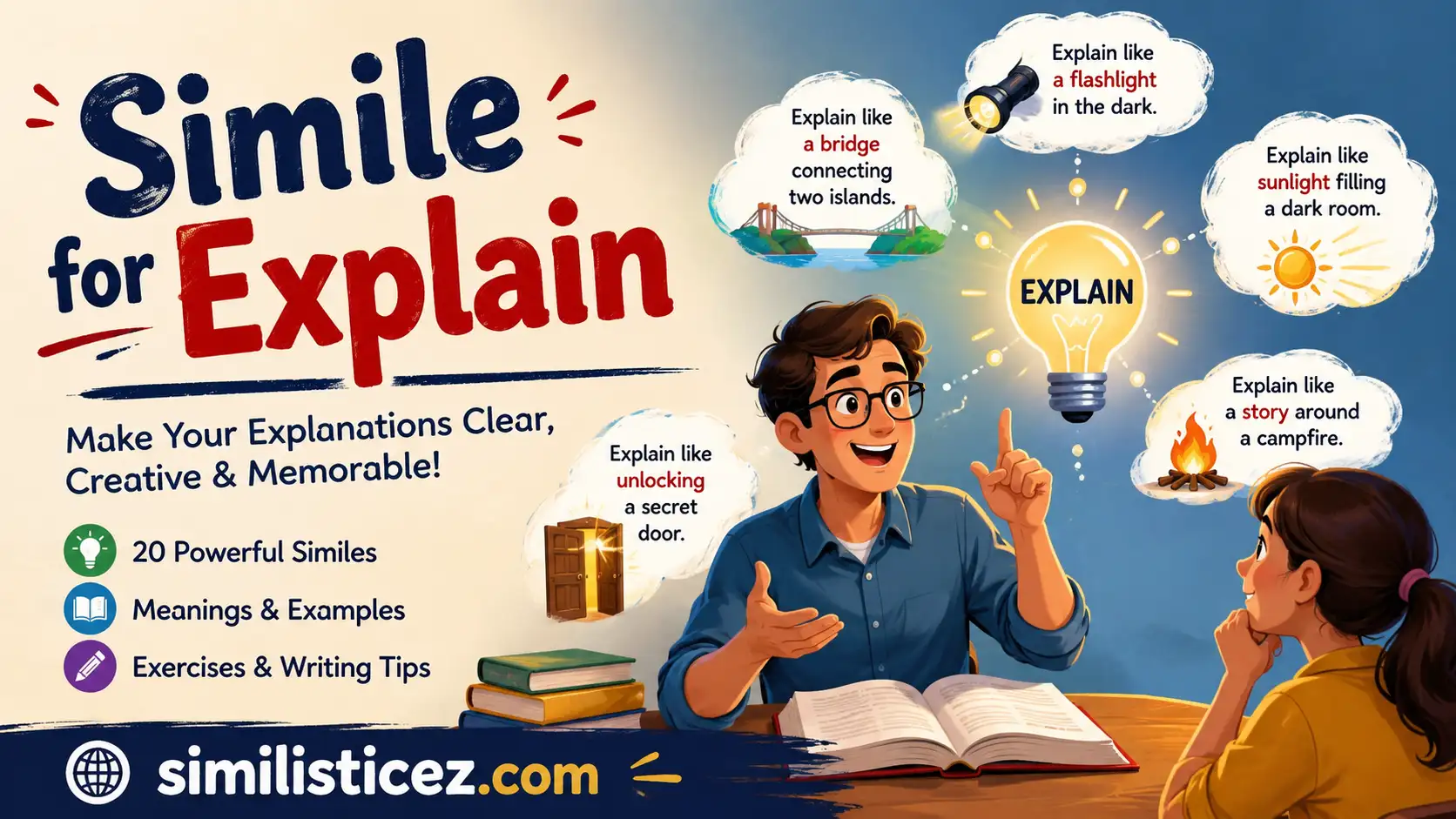
25 Simile for Explain: Meanings, Examples, and Another Word for Explain (2026)
Explaining something well is a skill, and words alone are not always enough. Sometimes the clearest explanation is a comparison. A simile for explain turns an abstract idea into a picture the reader can see, which makes the meaning stick. Instead of saying I will explain this clearly, a writer can say I will explain it like sunlight filling a dark room, and the reader instantly understands the promise.
In this guide, you will find 25 similes for explain with clear meanings and practical example sentences. You will also find a complete section on another word for explain, including the best synonyms for explain in an essay and in formal writing, plus practice exercises and FAQs to sharpen your skills.
What Is a Simile for Explain
A simile is a comparison between two different things using like or as. A simile for explain compares the act of explaining with something familiar: light removing darkness, a guide leading a traveler, or a teacher helping a student. These comparisons make the explanation itself feel vivid before it even begins.
Similes for explain are useful in stories, essays, speeches, teaching, and everyday conversation. They work because explaining is invisible. You cannot see understanding happen, but you can see sunlight fill a room, and that image carries the meaning for you.
Similes for Explain That Show Clarity
The first group of similes describes explanations that bring sudden understanding, like light chasing away darkness.
1. Explain Like Sunlight Filling a Dark Room
Meaning: To make something suddenly easy to understand. Example: His words explained the topic like sunlight filling a dark room.
2. Explain Like a Flashlight in the Dark
Meaning: To remove confusion and show the way forward. Example: The guide explained the directions like a flashlight in the dark.
3. Explain Like Turning on a Light Bulb
Meaning: To cause a sudden moment of understanding. Example: Dad explained the lesson like turning on a light bulb.
4. Explain Like Wiping Fog off a Mirror
Meaning: To clear away confusion so the truth shows plainly. Example: Her summary explained the problem like wiping fog off a mirror.
5. Explain Like Rain Washing Dust Away
Meaning: To clear confusion completely and leave fresh understanding. Example: Her explanation was like rain washing dust away.
6. Explain Like Wind Moving the Clouds Away
Meaning: To remove uncertainty and reveal a clear sky of understanding. Example: His explanation was like wind moving the clouds away.
7. Explain Like Lighting Candles in a Dark Hallway
Meaning: To bring understanding to one part of a topic at a time. Example: The tutor explained the chapter like lighting candles in a dark hallway.
Similes for Explain That Show Step by Step Guidance
Good explanations often build one step at a time. These similes describe careful, orderly teaching.
8. Explain Like a Teacher Guiding a Classroom
Meaning: To explain something clearly and patiently. Example: She explained the math problem like a teacher guiding a classroom.
9. Explain Like a GPS Guiding Travelers
Meaning: To give clear directions or guidance toward understanding. Example: The instructor explained the steps like a GPS guiding travelers.
10. Explain Like Building Blocks Stacking Together
Meaning: To explain one step at a time in a clear order. Example: The coach explained the exercise like building blocks stacking together.
11. Explain Like a Chef Sharing a Recipe
Meaning: To explain with clear, followable instructions. Example: Mom explained the process like a chef sharing a recipe.
12. Explain Like Stitching Pieces into a Quilt
Meaning: To combine ideas carefully into a complete picture. Example: She explained the project like stitching pieces into a quilt.
13. Explain Like a Bridge Connecting Two Islands
Meaning: To connect ideas together smoothly. Example: He explained the lesson like a bridge connecting two islands.
14. Explain Like Water Flowing Through a River
Meaning: To explain smoothly and naturally, without forcing. Example: She explained the story like water flowing through a river.
Similes for Explain That Show Patience and Growth
Some ideas cannot be understood in a moment. These similes describe explanations that take time and care.
15. Explain Like Peeling Layers of an Onion
Meaning: To explain something gradually, layer by layer. Example: The lawyer explained the case like peeling layers of an onion.
16. Explain Like a Gardener Planting Seeds
Meaning: To help ideas grow slowly in the mind. Example: The professor explained philosophy like a gardener planting seeds.
17. Explain Like Untangling a Knot
Meaning: To solve confusion carefully, one thread at a time. Example: She explained the argument like untangling a knot.
18. Explain Like a Painter Adding Colors to a Canvas
Meaning: To explain with vivid, imaginative detail. Example: Grandpa explained the old days like a painter adding colors to a canvas.
19. Explain Like Reading Subtitles in a Movie
Meaning: To make difficult things understandable for everyone. Example: My friend explained the joke like reading subtitles in a movie.
Similes for Explain That Show Discovery and Revelation
The final group describes explanations that feel like uncovering something hidden or exciting.
20. Explain Like Opening a Treasure Map
Meaning: To reveal information step by step with excitement. Example: The scientist explained the process like opening a treasure map.
21. Explain Like Unlocking a Secret Door
Meaning: To reveal hidden understanding. Example: The teacher explained science like unlocking a secret door.
22. Explain Like a Storyteller Around a Campfire
Meaning: To explain in an engaging, memorable way. Example: Grandma explained family history like a storyteller around a campfire.
23. Explain Like Handing Someone a Key
Meaning: To give a person the one idea that unlocks everything else. Example: His simple example explained the theory like handing someone a key.
24. Explain Like Translating a Foreign Language
Meaning: To turn expert language into words anyone can understand. Example: The doctor explained the diagnosis like translating a foreign language.
25. Explain Like a Dictionary Opening at the Right Page
Meaning: To give the exact definition a person was looking for. Example: Her answer explained the term like a dictionary opening at the right page.
Another Word for Explain: Synonyms for Essays and Formal Writing
Sometimes a simile is not what you need. Sometimes you simply need another word for explain to avoid repeating yourself. Choosing the right synonym keeps your writing fresh and precise, especially in academic work.
Best Synonyms for Explain in an Essay
Academic writing rewards variety and precision. These synonyms for explain in an essay are safe for school and university work:
- Discuss: to examine a topic from several sides. Example: This essay will discuss the causes of the conflict.
- Analyze: to break a topic into parts and study each one. Example: The paper analyzes the data in three sections.
- Illustrate: to make a point clear with examples. Example: The chart illustrates the change over ten years.
- Clarify: to remove confusion about a point. Example: The author clarifies the term in the introduction.
- Elaborate: to add more detail to an idea. Example: The writer elaborates on the theory in chapter two.
- Demonstrate: to show how something works with evidence. Example: The experiment demonstrates the principle clearly.
- Interpret: to explain the meaning of something complex. Example: Critics interpret the poem in different ways.
Formal Synonyms for Explain
For reports, presentations, and professional writing, these formal choices work well: elucidate (to make clear and easy to understand), expound (to explain in full detail), explicate (to analyze and develop an idea), delineate (to describe precisely), and articulate (to express clearly in words).
Everyday Synonyms for Explain
In conversation and casual writing, simpler words fit better: describe, spell out, walk through, break down, lay out, and go over. Example: Let me walk you through the steps before we start.
Antonyms of Explain
Knowing the opposites sharpens your understanding: confuse, conceal, complicate, obscure, and misrepresent. An antonym shows what an explanation is fighting against, which is confusion.
How to Use Explain Similes in Your Writing
Follow these tips to get the most from your new similes:
- Match the simile to the situation. Use clarity similes like explain like a flashlight in the dark for moments of confusion, and patience similes like explain like a gardener planting seeds for slow learning.
- Use similes in introductions. Opening an essay or speech with a vivid comparison, such as explain like opening a treasure map, grabs attention immediately.
- Do not overuse them in academic essays. One well-placed simile per essay is enough. Essays value clarity first, so pair your synonyms like analyze and illustrate with plain, strong sentences.
- Keep the image consistent. If you start with a light image, stay with light images through the paragraph. Mixing a flashlight, a quilt, and a treasure map in one paragraph confuses the reader.
- Practice in everyday speech. Try explaining a recipe like a chef sharing a recipe or a game rule like a GPS guiding travelers. Daily practice makes the similes natural.
Practice Exercise: Test Yourself
Check your understanding with these quick questions. Answers follow each question.
Question 1: Complete the simile
He explained the lesson like a ______ in the dark.
Answer: Flashlight. A flashlight removes darkness, just as a good explanation removes confusion.
Question 2: Which simile means to explain gradually, layer by layer?
Answer: Explain like peeling layers of an onion. It suggests depth and careful detail.
Question 3: Fill in the blank
She explained the story like water flowing through a ______.
Answer: River. The image suggests smooth, natural explanation.
Question 4: Which synonym for explain fits best in a formal essay: walk through or analyze?
Answer: Analyze. It is precise and academic, while walk through is casual.
Question 5: Complete the simile
The tutor explained the chapter like ______ candles in a dark hallway.
Answer: Lighting. The simile shows understanding arriving one part at a time.
Question 6: Which simile shows that an explanation gives someone the key idea?
Answer: Explain like handing someone a key. One idea unlocks everything else.
Explaining something well is a skill, and words alone are not always enough. Sometimes the clearest explanation is a comparison. A simile for explain turns an abstract idea into a picture the reader can see, which makes the meaning stick. Instead of saying I will explain this clearly, a writer can say I will explain it like sunlight filling a dark room, and the reader instantly understands the promise.
In this guide, you will find 35 similes for explain grouped by meaning, each with a clear meaning and an example sentence. You will also get the best synonyms for explain in an essay, plus practice exercises, classroom tips, and FAQs.
Similes for Explain That Show Discovery and Revelation
The next group describes explanations that feel like uncovering something hidden or exciting.
22. Explain Like Opening a Treasure Map
Meaning: To reveal information step by step with excitement. Example: The scientist explained the process like opening a treasure map.
23. Explain Like Unlocking a Secret Door
Meaning: To reveal hidden understanding. Example: The teacher explained science like unlocking a secret door.
24. Explain Like a Storyteller Around a Campfire
Meaning: To explain in an engaging, memorable way. Example: Grandma explained family history like a storyteller around a campfire.
25. Explain Like Handing Someone a Key
Meaning: To give a person the one idea that unlocks everything else. Example: His simple example explained the theory like handing someone a key.
26. Explain Like Translating a Foreign Language
Meaning: To turn expert language into words anyone can understand. Example: The doctor explained the diagnosis like translating a foreign language.
27. Explain Like a Dictionary Opening at the Right Page
Meaning: To give the exact definition a person was looking for. Example: Her answer explained the term like a dictionary opening at the right page.
28. Explain Like a Sunrise Over a Foggy Valley
Meaning: To bring slow, beautiful understanding after a period of confusion. Example: The lecture explained the theory like a sunrise over a foggy valley.
Similes for Explain for Classrooms and Everyday Talk
The final group gives you fresh, original similes built for teachers, students, and daily conversation.
29. Explain Like a Coach Drawing Plays on a Whiteboard
Meaning: To lay out a plan so clearly that everyone knows their role. Example: The manager explained the project like a coach drawing plays on a whiteboard.
30. Explain Like a Friend Showing a Shortcut on a Map
Meaning: To make a complicated route feel simple and friendly. Example: She explained the commute like a friend showing a shortcut on a map.
31. Explain Like a Mechanic Opening the Car Hood
Meaning: To reveal how something really works inside. Example: The engineer explained the engine like a mechanic opening the car hood.
32. Explain Like a Cook Tasting the Soup Before Serving
Meaning: To check and adjust an explanation until it tastes right. Example: The teacher explained the lesson like a cook tasting the soup before serving.
33. Explain Like a Librarian Finding the Right Book
Meaning: To guide someone to exactly the knowledge they need. Example: My mentor explained the topic like a librarian finding the right book.
34. Explain Like a Pilot Announcing the Flight Path
Meaning: To calmly tell people what to expect before the journey begins. Example: The speaker explained the agenda like a pilot announcing the flight path.
35. Explain Like a Musician Tuning an Instrument
Meaning: To adjust small details until everything sounds right. Example: The editor explained the revision like a musician tuning an instrument.
How to Use Explain Similes in Essays, Speeches, and Class
- Match the simile to the situation. Use clarity similes like explain like a flashlight in the dark for confusion, and patience similes like explain like a gardener planting seeds for slow learning.
- Use similes in introductions. Opening an essay or speech with a vivid comparison, such as explain like opening a treasure map, grabs attention immediately.
- Do not overuse them in academic essays. One well-placed simile per essay is enough. Pair synonyms like analyze and illustrate with plain, strong sentences.
- Keep the image consistent. If you start with a light image, stay with light images through the paragraph.
- Practice in everyday speech. Try explaining a recipe like a chef sharing a recipe or a game rule like a GPS guiding travelers. Daily practice makes the similes natural.
FAQs
What is another word for explain in an essay?
The best choices are discuss, analyze, illustrate, clarify, elaborate, and demonstrate. Pick the one that matches your exact meaning: use analyze for breaking ideas into parts, and illustrate when you support a point with examples.
What are good synonyms for explain in detail?
Use elucidate, expound, explicate, or break down. For example: The professor expounded the theory for a full hour.
What is the difference between a simile and a metaphor for explaining?
A simile uses like or as, for example explain like a flashlight in the dark. A metaphor compares directly without those words, for example his explanation was a flashlight in the dark. Both work, but similes are gentler and easier for beginners.
Can I use similes in formal essays?
Yes, but sparingly. One well-chosen simile can open an essay beautifully. The body of the essay should rely on precise synonyms like analyze and illustrate, with clear topic sentences carrying the argument.
How do similes make explanations better?
Similes turn invisible thinking into visible pictures. When you say explain like sunlight filling a dark room, the reader feels the relief of understanding before the explanation even starts. That emotional preview makes people pay closer attention.
How can I create my own simile for explain?
Think about what explaining feels like: bringing light, building something, or guiding someone. Then finish the sentence explaining is like… with a familiar image. The best ones come from your own experience, such as teaching a younger sibling or learning a new game.
Explain Similes for Difficult Conversations
Some explanations are hard not because the topic is complex, but because feelings run high. Apologies, bad news, and disagreements all need explanations that lower defences instead of raising them. A gentle explain simile can do that work. Saying, let me explain this like untangling a knot, slowly, one thread at a time, promises patience and care before the hard part begins. The listener hears that you will not rush, judge, or overwhelm them.
In difficult conversations, avoid grand or clever similes, because they can sound like showing off when someone is upset. Choose small, humble images instead: lighting one candle at a time, walking a path together, opening a window a little at a time. These images suggest partnership, not performance. They tell the listener that understanding will be built together, step by step, rather than delivered as a lecture.
After the explanation, check understanding with a question, not a test. Ask, does that part make sense, or would another example help, and mean it. A good explanation in a hard conversation ends with the other person feeling heard, not defeated. If they still look confused, try a different image rather than repeating the same one louder. Changing the comparison often unlocks the meaning that repetition cannot.
Explain Similes That Use Everyday Objects
Everyday objects make the best explain similes, because every reader already knows them. A recipe explains a process, a map explains a journey, a key explains a solution, a bridge explains a connection. When you build a simile from an object your reader touches daily, you remove one barrier to understanding: the reader does not need to learn the comparison before learning the idea.
Try this exercise the next time you must explain something tricky. List five objects on your desk or in your kitchen, then ask how each one resembles your topic. A kettle explains pressure building slowly. A ladder explains progress step by step. A puzzle explains pieces fitting into a whole. A torch explains focus on one dark corner at a time. One of those five will usually fit better than any abstract image you invent from scratch.
Everyday object similes also help younger readers and learners of English, because the vocabulary stays simple. A child who has never heard the word elucidate will still understand an explanation compared to building with blocks. Keep the object familiar, keep the sentence short, and let the comparison do the explaining. The simplest image that works is almost always the best one.
Frequently Asked Questions
Can an explain simile open a speech?
Yes, and it often works beautifully. Opening with a vivid comparison, such as explaining like lighting candles in a dark hallway, promises the audience clarity and holds their attention from the first line.
Which explain simile fits a science lesson?
Choose a practical image tied to the topic, such as a mechanic opening a car hood for how things work inside, or a gardener planting seeds for ideas that grow slowly over time.
How many explain similes should one essay hold?
One is usually enough for a short essay. A second simile is fine in a long piece if it appears in a different section and uses a different image family, such as light in one part and building in another.
What makes an explain simile fail?
A simile fails when the comparison is harder than the idea itself, or when two images collide in one sentence. If the reader must stop and decode the simile, it has added confusion instead of removing it.
Conclusion
A strong simile for explain does more than decorate a sentence. It promises the reader that understanding is coming, and it delivers that promise in a picture. Whether you explain like a flashlight in the dark, like a teacher guiding a classroom, or like opening a treasure map, the comparison makes your words clearer and more memorable.
Pair these similes with the right synonyms. Reach for another word for explain like analyze or illustrate in essays, and save vivid similes for openings, stories, and speeches. Practice the exercises above, create a few similes of your own, and your explanations will start landing exactly the way you want them to.