I want to share something that caught my attention recently. While reading an article and scrolling through a few online discussions, I noticed that certain words and actions kept appearing again and again.
It made me wonder how writers describe repetition in a more creative and engaging way. That’s when I started exploring similes for repetition.
At first, I thought repetition was just about doing or saying the same thing repeatedly. But as I dug deeper, I discovered that similes can make these descriptions much more vivid and memorable.
If you’re writing a story, poem, essay, or even a social media caption, the right simile can help you express repetition in a way that instantly connects with readers.
In this guide, I’ll share some of the best similes for repetition, their meanings, and practical examples so you can use them confidently in your own writing.
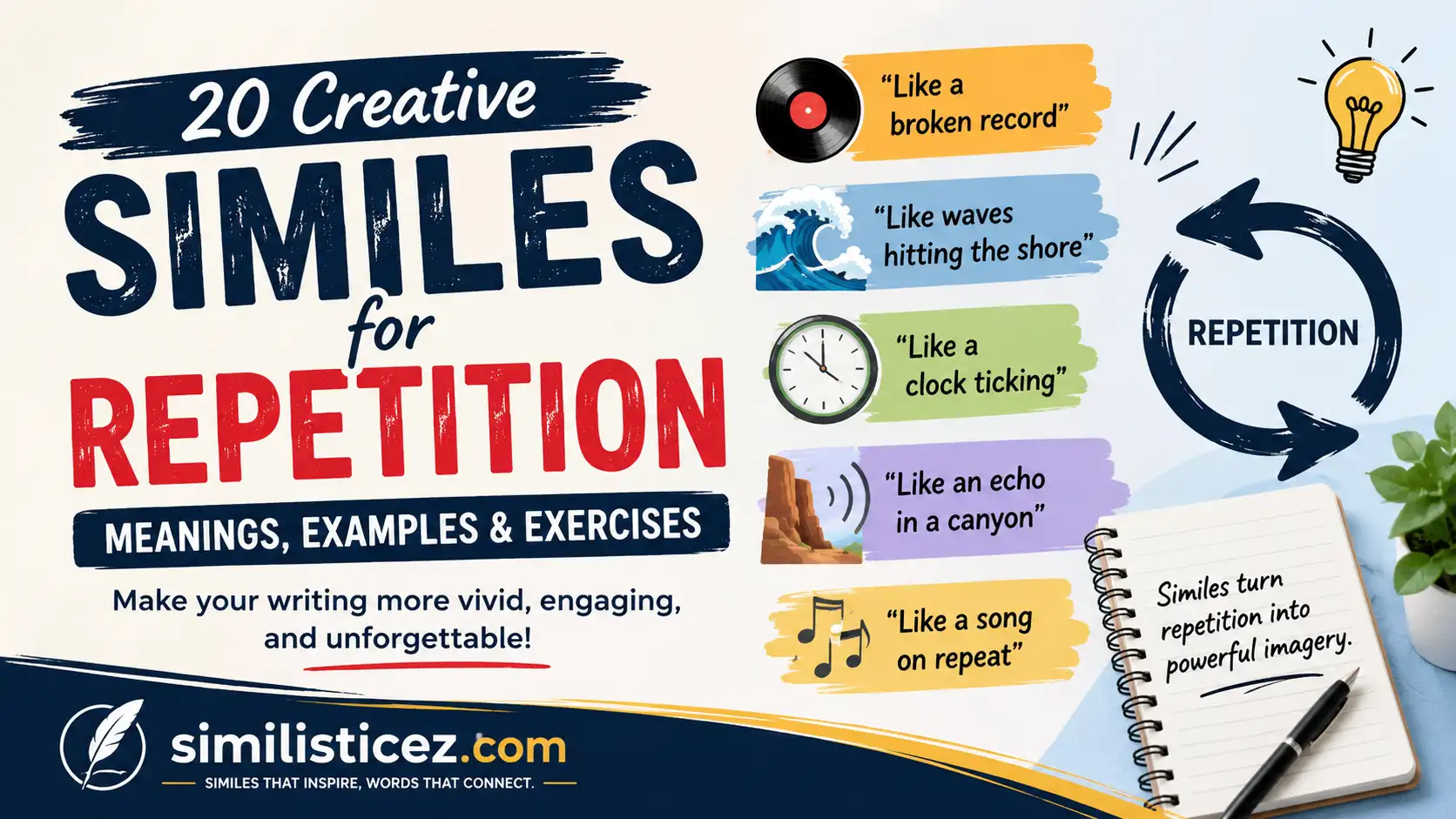
20 Similes for Repetition
1. Like a broken record
Meaning: Something repeated over and over.
Explanation: This simile compares repetition to a damaged record that keeps playing the same part.
Examples:
- He sounded like a broken record when he repeated the same warning.
- My little brother was like a broken record asking for ice cream.
2. Like waves hitting the shore
Meaning: Continuous repetition.
Explanation: Waves return again and again without stopping.
Examples:
- Her thoughts returned like waves hitting the shore.
- The reminders came like waves hitting the shore every day.
3. Like a clock ticking
Meaning: Regular and predictable repetition.
Explanation: A clock repeats the same movement constantly.
Examples:
- His routine was like a clock ticking.
- The announcements came like a clock ticking every hour.
4. Like an echo in a canyon
Meaning: Words or sounds repeating.
Explanation: Echoes naturally repeat sounds.
Examples:
- Her words lingered like an echo in a canyon.
- The slogan spread like an echo in a canyon.
5. Like a song on repeat
Meaning: Something happening again and again.
Explanation: A song replayed continuously creates repetition.
Examples:
- That memory played like a song on repeat.
- His excuse sounded like a song on repeat.
6. Like footsteps in a hallway
Meaning: A recurring sound or action.
Explanation: Footsteps often create rhythmic repetition.
Examples:
- The noise came like footsteps in a hallway.
- Her worries returned like footsteps in a hallway.
7. Like the seasons returning
Meaning: Repetition over time.
Explanation: Seasons follow the same cycle each year.
Examples:
- Their traditions returned like the seasons.
- The problem appeared like the seasons returning.
8. Like raindrops on a roof
Meaning: Frequent repetition.
Explanation: Raindrops strike repeatedly and steadily.
Examples:
- Questions fell like raindrops on a roof.
- The complaints came like raindrops on a roof.
9. Like a spinning wheel
Meaning: Endless repetition.
Explanation: A wheel turns in the same pattern.
Examples:
- The discussion felt like a spinning wheel.
- His thoughts moved like a spinning wheel.
10. Like a drumbeat
Meaning: Steady repetition.
Explanation: Drumbeats follow a repeated rhythm.
Examples:
- The message returned like a drumbeat.
- Her name echoed like a drumbeat.
11. Like breathing
Meaning: Natural repetition.
Explanation: Breathing happens continuously without effort.
Examples:
- Practice became like breathing to him.
- The habit continued like breathing.
12. Like the tide coming in
Meaning: Regular repetition.
Explanation: Tides follow predictable cycles.
Examples:
- The visitors arrived like the tide coming in.
- The memories returned like the tide.
13. Like a revolving door
Meaning: Constant repetition of people or events.
Explanation: A revolving door keeps moving in circles.
Examples:
- Employees came and went like a revolving door.
- Excuses appeared like a revolving door.
14. Like pages turning in a book
Meaning: Repeating progression.
Explanation: Turning pages follows a recurring action.
Examples:
- Days passed like pages turning in a book.
- The lessons repeated like pages turning.
15. Like a pendulum swinging
Meaning: Back-and-forth repetition.
Explanation: A pendulum repeats the same motion.
Examples:
- His mood changed like a pendulum swinging.
- The argument continued like a pendulum.
16. Like birds returning to a nest
Meaning: Repetition through habit.
Explanation: Birds often return to the same place.
Examples:
- The idea returned like birds to a nest.
- Customers arrived like birds returning home.
17. Like traffic lights changing
Meaning: Predictable repetition.
Explanation: Traffic lights follow a repeated cycle.
Examples:
- The process moved like traffic lights changing.
- Events repeated like traffic lights.
18. Like a heartbeat
Meaning: Constant repetition.
Explanation: Heartbeats occur repeatedly and steadily.
Examples:
- The rhythm continued like a heartbeat.
- The sound pulsed like a heartbeat.
19. Like the sunrise each morning
Meaning: Daily repetition.
Explanation: Sunrise happens every day.
Examples:
- Her greetings came like the sunrise.
- The routine returned like the sunrise.
20. Like a boomerang
Meaning: Something that keeps coming back.
Explanation: A boomerang returns after being thrown.
Examples:
- The rumor came back like a boomerang.
- The same issue returned like a boomerang.
Practical Exercise: Test Your Knowledge
Questions
- Complete the simile: “The excuse returned like a ______.”
- Which simile compares repetition to nature?
- What does “like a broken record” mean?
- Complete: “The reminders came like ______ hitting the shore.”
- Which simile suggests a daily cycle?
- Identify the simile: “His words echoed like a drumbeat.”
- Complete: “The habit continued like ______.”
- Which simile shows back-and-forth repetition?
- Complete: “The memory played like a ______ on repeat.”
- Which simile describes something that keeps returning?
Answers and Explanations
- Broken record – repeated constantly.
- Like waves hitting the shore – nature repeats continuously.
- Repeating the same thing again and again.
- Waves.
- Like the sunrise each morning.
- Like a drumbeat.
- Breathing.
- Like a pendulum swinging.
- Song.
- Like a boomerang.
Simile for Repetition in Literature
Writers often use similes such as “like a broken record” or “like an echo in a canyon” to emphasize recurring actions, themes, or ideas in literature.
Simile for Repetition in a Sentence
Example:
“The teacher’s reminder was like a broken record, repeating the same instructions every day.”
Another Word for Repetition in Literature
Some alternatives include:
- Recurrence
- Reiteration
- Repetition
- Redundancy
- Refrain
Repetition Antonyms
Common antonyms include:
- Change
- Variation
- Difference
- Innovation
- Originality
Repetition Synonym and Antonym
Synonyms: recurrence, reiteration, duplication, repetition.
Antonyms: variation, uniqueness, originality, change.
Another Word for Repetition in an Essay
You might use:
- Reiteration
- Restatement
- Recurrence
- Reinforcement
Repetition Synonyms (4 Letters)
Some four-letter alternatives include:
- Echo
- Copy
Repetition Examples
- A chorus repeated in a song.
- A slogan repeated in advertising.
- A phrase repeated in a speech.
- Daily routines repeated each morning.
FAQs
What is a simile for repetition?
A simile for repetition compares repeated actions or events to something familiar, such as a broken record or an echo.
Why do writers use similes?
Writers use similes to create vivid images and make ideas easier to understand.
What is the most common simile for repetition?
“Like a broken record” is one of the most popular examples.
Can similes improve creative writing?
Yes. Similes make descriptions more engaging and memorable.
How can I create my own simile?
Think of something that repeats naturally and compare it using “like” or “as.”
Conclusion
Similes are a powerful way to make writing more colorful and engaging. When describing repetition, comparisons such as “like a broken record,” “like waves hitting the shore,” or “like a heartbeat” help readers understand the idea instantly.
These creative writing similes add depth, emotion, and clarity to your work. As you’ve seen through these examples of similes, even a simple comparison can transform an ordinary sentence into something memorable.
The best way to improve is through practice. Try creating your own simile sentences based on things you see every day. The more you experiment, the easier it becomes to understand the meaning of similes and how to use similes in writing effectively.