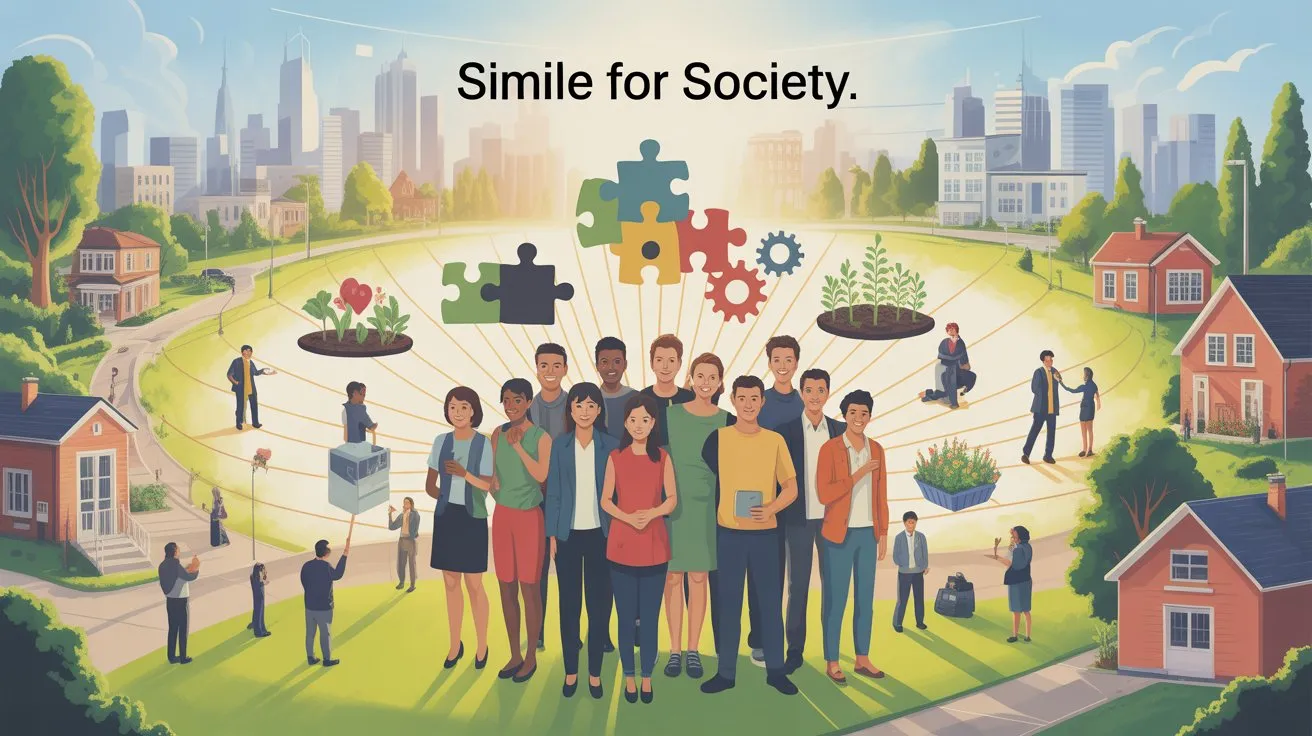
Society is the invisible web that connects us all, the shared rules, roles, and rhythms of human life together. Describing something that big takes a strong image. A simile for society turns the abstract idea of community into something readers can picture, like a beehive humming with purpose or a tapestry woven from a thousand threads. This collection offers 75 complete similes for society, grouped by theme, each with a short explanation of what it conveys. Use them in essays, speeches, debates, or stories to make big ideas about social life feel concrete and clear.
Nature Similes for Society
The natural world is full of models for how humans live together.
Like a beehive humming with purpose, society buzzed with coordinated work. This conveys organized collective labor toward shared goals.
Like an anthill after the rain, the community rebuilt quickly. This suggests resilience and instinctive cooperation.
Like a coral reef, society grew from countless tiny contributions. This conveys beauty built slowly by many small lives.
Like a forest with deep roots, the culture drew strength from history. This suggests tradition anchoring the present.
Like a flock of starlings, the crowd moved as one mind. This conveys mesmerizing, leaderless coordination.
Like a wolf pack, the group protected its own fiercely. This suggests loyalty with a sharp edge.
Like a garden with many species, the city thrived on diversity. This conveys the strength of varied contributions.
Like the ocean’s food chain, every level depended on the one below. This suggests interdependence with harsh realities.
Like a mycelium network underground, connections ran invisibly everywhere. This conveys hidden, vast interconnection.
Like a river delta, the culture split into many channels. This suggests one source branching into diverse expressions.
Craft and Building Similes
Societies are built, so craft images fit naturally.
Like a tapestry woven from a thousand threads, society held together through difference. This conveys beauty made from variety.
Like a brick wall, the community stood firm against pressure. This suggests solid, unified strength.
Like a patchwork quilt, the nation stitched mismatched pieces into warmth. This conveys comfort made from fragments.
Like a bridge under construction, the culture was unfinished and ambitious. This suggests progress with visible gaps.
Like a mosaic, society formed a picture from broken pieces. This conveys wholeness assembled from fragments.
Like a house with many rooms, the community offered space for every life. This suggests inclusive structure.
Like scaffolding around a tower, traditions supported new growth. This conveys old structures enabling new building.
Like a loom with tangled threads, the social fabric knotted in places. This suggests complexity with problem spots.
Like a potter’s wheel, the culture shaped its people while spinning. This conveys mutual forming of individuals and norms.
Like a cathedral built over centuries, the institutions outlasted their builders. This suggests long, collective creation.
Machine and System Similes
Like a clockwork mechanism, society ticked through its routines. This conveys precise, predictable order.
Like a vast machine with many gears, every role turned the next. This suggests interdependence with mechanical precision.
Like an orchestra without a conductor, the crowd found its own rhythm. This conveys self organizing harmony.
Like a computer network, the community shared information instantly. This suggests modern, digital connection.
Like a pressure cooker, the tensions built toward release. This conveys social stress nearing a breaking point.
Like a well oiled engine, the economy hummed efficiently. This suggests smooth, productive function.
Like a circuit with a blown fuse, one failure darkened the whole system. This conveys cascading breakdown.
Like a vending machine, the bureaucracy dispensed identical outcomes. This suggests impersonal, standardized treatment.
Like an assembly line, the schools produced uniform graduates. This conveys industrial scale socialization.
Like a thermostat, the culture self corrected toward the norm. This suggests automatic regulation of deviance.
Body and Organism Similes
Like a living body, society felt pain in one part and ached everywhere. This conveys deep, organic interconnection.
Like an immune system, the culture attacked foreign ideas. This suggests defensive rejection of the unfamiliar.
Like a nervous system, news traveled instantly to every corner. This conveys rapid, sensitive communication.
Like a heart pumping blood, the city center fed the suburbs. This suggests a vital core sustaining the whole.
Like scar tissue, the community healed but stayed marked. This conveys recovery that remembers trauma.
Like a fever breaking, the crisis passed and calm returned. This suggests the relief after social upheaval.
Like muscles remembering exercise, the traditions held their shape. This conveys embodied, habitual culture.
Like a growing child, the young nation outgrew its old clothes. This suggests development outpacing institutions.
Like white blood cells, the reformers rushed to the wound. This conveys healing responses to social injury.
Like a spine, the shared values held everything upright. This suggests core principles providing structure.
Everyday Life Similes
Like a crowded subway car, society pressed strangers together. This conveys forced intimacy in urban life.
Like a potluck dinner, the culture mixed everyone’s contributions. This suggests festive, voluntary sharing.
Like a group chat, the discourse moved fast and fragmented. This conveys modern, scattered public conversation.
Like a neighborhood watch, the community policed itself. This suggests informal social control.
Like a school cafeteria, the social order sorted itself into tables. This conveys visible, rigid hierarchy.
Like a family reunion, the nation gathered with love and tension. This suggests affection mixed with old conflicts.
Like a traffic jam, progress stalled from too many drivers. This conveys gridlock caused by individual choices.
Like a farmers market, the economy buzzed with small sellers. This suggests vibrant, local exchange.
Like a choir singing in harmony, the movement found one voice. This conveys powerful, unified expression.
Like a book club arguing over the ending, the debate was passionate and civil. This suggests healthy democratic disagreement.
More Thoughtful Similes for Society
Like a spider’s web, the social connections trembled at every touch. This conveys delicate, responsive interconnection.
Like a tide, public opinion pulled everything with it. This suggests powerful, shifting collective force.
Like a mirror maze, the culture reflected itself endlessly. This conveys self absorption in media age.
Like a campfire, the shared story drew everyone close. This suggests narrative as social glue.
Like a storm system, the unrest gathered and released. This conveys cyclical social turbulence.
Like a library, the civilization stored its memory. This suggests institutions as collective mind.
Like a garden that needs weeding, the democracy required constant care. This conveys civic maintenance.
Like a relay race, each generation passed the baton. This suggests continuity through handoff.
Like a quilt with a loose thread, one unraveling threatened the whole. This conveys vulnerability in unity.
Like a stage play, social life followed scripts. This suggests performed roles in daily interaction.
Like a beehive in winter, the community conserved its warmth. This conveys huddled resilience in hard times.
Like a marketplace of ideas, the discourse traded in thoughts. This suggests competitive intellectual exchange.
Like a ship with many captains, the leadership pulled in directions. This conveys fragmented authority.
Like a forest fire clearing deadwood, the upheaval made room for growth. This suggests destruction enabling renewal.
Like a song everyone knows, the shared culture united strangers. This conveys the bonding power of common reference.
How to Use Society Similes in Writing
Society similes work best when they make the abstract concrete. Pick an image your reader can see and touch, then connect it clearly to your point about social life. Match the simile to your argument. A beehive supports a point about cooperation, while a pressure cooker supports a point about tension. Use them as openers. A strong society simile in your first paragraph gives readers an anchor for complex ideas. Finally, extend the image. If society is a tapestry, you can later mention loose threads and weaving, which makes your essay feel unified.
Common Mistakes to Avoid
The biggest mistake is mixing incompatible images. Do not call society a beehive in one paragraph and a machine in the next without a reason, because readers get confused. Another error is oversimplifying. A single simile cannot capture all of society, so acknowledge what your image leaves out. Writers also lean on clichés. The melting pot has been used ten thousand times, so reach for fresher images like a mycelium network. Finally, avoid preaching. Let the simile illuminate your point instead of hammering it.
Society is the invisible web that connects us all, the shared rules, roles, and rhythms of human life. Describing something that large takes a strong image. A simile for society turns the abstract idea of community into something readers can picture, like a beehive humming with purpose or a tapestry woven from a thousand threads. This collection offers 75 complete similes for society, grouped by theme, each with a short explanation of what it conveys. You will also find a guide for matching each simile to your argument, practical usage tips, common mistakes to avoid, and answers to the most asked questions. Use these comparisons in essays, speeches, debates, or stories to make big ideas about social life feel concrete and clear.
Nature Similes for Society
The natural world is full of models for how humans live together.
1. Like a beehive humming with purpose, the community worked in coordinated harmony toward shared goals.
2. Like an anthill after the rain, the neighborhood rebuilt quickly through instinctive cooperation.
3. Like a coral reef, the culture grew from countless tiny contributions over many years.
4. Like a forest with deep roots, the nation drew strength from traditions buried in history.
5. Like a flock of starlings, the crowd shifted direction as if guided by one mind.
6. Like a wolf pack, the group defended its own members with fierce loyalty.
7. Like a garden with many species, the city thrived because every culture added something different.
8. Like the ocean food chain, every level of the economy depended on the one below it.
9. Like a mycelium network underground, the connections between people ran invisibly in every direction.
10. Like a river delta, the culture split from one source into many winding channels.
Craft and Building Similes for Society
Societies are built, so images of making and construction fit naturally.
11. Like a tapestry woven from a thousand threads, the nation held together through beautiful differences.
12. Like a brick wall, the community stood firm when outside pressure mounted.
13. Like a patchwork quilt, the country stitched mismatched pieces into something warm.
14. Like a bridge under construction, the culture felt unfinished yet full of ambition.
15. Like a mosaic, the society formed a complete picture from scattered fragments.
16. Like a house with many rooms, the community offered a place for every kind of life.
17. Like scaffolding around a tower, old traditions supported new ideas as they rose.
18. Like a loom with tangled threads, the social fabric knotted badly in certain places.
19. Like a potter wheel, the culture shaped its people even as they shaped it.
20. Like a cathedral built over centuries, the institutions outlasted the builders who started them.
Machine and System Similes for Society
Modern life runs on systems, and these comparisons capture that machinery.
21. Like a clockwork mechanism, the town ticked through its daily routines with precise order.
22. Like a vast machine with many gears, every social role turned the one beside it.
23. Like an orchestra without a conductor, the crowd somehow found its own rhythm.
24. Like a computer network, the community passed information instantly from node to node.
25. Like a pressure cooker, public tension built silently toward a sudden release.
26. Like a well oiled engine, the economy ran smoothly when every part did its job.
27. Like a circuit with a blown fuse, one failure darkened the entire system at once.
28. Like a vending machine, the bureaucracy delivered identical outcomes to every person.
29. Like an assembly line, the schools turned out graduates with uniform skills.
30. Like a thermostat, the culture quietly corrected anyone who drifted from the norm.
Body and Organism Similes for Society
These comparisons treat society as a living thing with health, pain, and healing.
31. Like a living body, the nation felt pain in one region and ached everywhere.
32. Like an immune system, the culture attacked unfamiliar ideas before understanding them.
33. Like a nervous system, news of the crisis traveled to every corner within minutes.
34. Like a heart pumping blood, the city center fed energy out to the suburbs.
35. Like scar tissue, the community healed from the disaster but carried the mark forever.
36. Like a fever breaking, the unrest passed and a strange calm returned.
37. Like muscles remembering exercise, the old traditions held their shape through habit.
38. Like a growing child, the young nation outgrew the institutions that once fit it.
39. Like white blood cells, the reformers rushed toward the wound in the social body.
40. Like a spine, the shared values held the whole structure upright.
Everyday Life Similes for Society
Ordinary scenes make excellent mirrors for social life.
41. Like a crowded subway car, the city pressed strangers into forced intimacy.
42. Like a potluck dinner, the culture mixed voluntary contributions from every household.
43. Like a group chat, public discussion moved fast and splintered into fragments.
44. Like a neighborhood watch, the community quietly policed its own behavior.
45. Like a school cafeteria, the social order sorted itself into visible tables.
46. Like a family reunion, the nation gathered with affection and old tension together.
47. Like a traffic jam, progress stalled because too many people drove at once.
48. Like a farmers market, the local economy buzzed with small independent sellers.
49. Like a choir singing in harmony, the movement discovered a single powerful voice.
50. Like a book club arguing over the ending, the debate stayed passionate yet civil.
Thoughtful Similes for Society
Deeper images for essays and speeches that need a reflective tone.
51. Like a spider web, the social connections trembled at the lightest touch.
52. Like a tide, public opinion pulled everything along with irresistible force.
53. Like a mirror maze, the media age reflected the culture back at itself endlessly.
54. Like a campfire, the shared story drew strangers close around its warmth.
55. Like a storm system, the unrest gathered slowly and then released all at once.
56. Like a library, the civilization stored its collective memory on crowded shelves.
57. Like a garden that needs weeding, the democracy demanded constant care from its citizens.
58. Like a relay race, each generation passed the baton to the next.
59. Like a quilt with a loose thread, one unraveling corner threatened the entire pattern.
60. Like a stage play, daily social life followed scripts everyone had memorized.
61. Like a beehive in winter, the community conserved its warmth through the hardest months.
62. Like a marketplace of ideas, public discourse traded thoughts in open competition.
63. Like a ship with many captains, the leadership pulled the country in opposite directions.
64. Like a forest fire clearing deadwood, the upheaval destroyed the old to make room for growth.
65. Like a song everyone knows, the shared culture united strangers in a single moment.
Modern Digital Similes for Society
Fresh, original comparisons for the connected age your readers live in.
66. Like a Wi-Fi network, the community connected invisibly and dropped out without warning.
67. Like a comment section, public debate turned loud, messy, and hard to moderate.
68. Like a software update, the culture transformed overnight while everyone slept.
69. Like a multiplayer game server, the city ran on shared rules that nobody had read.
70. Like a viral trend, the new idea spread faster than anyone could explain it.
71. Like a smartphone with too many apps, the society slowed down under its own complexity.
72. Like a cloud storage drive, the collective memory lived somewhere nobody could see.
73. Like a search engine, the culture answered every question while shaping which ones got asked.
74. Like a shared playlist, everyone added a song but nobody agreed on the mood.
75. Like a smart home system, the society automated itself and forgot how the old switches worked.
How to Match a Society Simile to Your Argument
The right simile strengthens your point, while the wrong one confuses readers. Use this guide to pick well.
If your argument is about cooperation, choose beehive, orchestra, or choir images. If you are writing about diversity as strength, reach for the tapestry, the garden with many species, or the mosaic. Arguments about tension and conflict fit the pressure cooker, the ship with many captains, or the quilt with a loose thread. When your topic is change and progress, the software update, the bridge under construction, or the relay race work best. For criticism of rigid systems, use the vending machine, the assembly line, or the thermostat.
Always extend the image through your paragraph. If society is a tapestry, mention loose threads and weaving later in the essay so the whole piece feels unified.
How to Use Society Similes in Essays and Speeches
Society similes work best when they make the abstract concrete. Pick an image your reader can see and touch, then connect it clearly to your point about social life. Match the simile to your argument as shown above. A beehive supports a point about cooperation, while a pressure cooker supports a point about tension. Use them as openers. A strong society simile in your first paragraph gives readers an anchor for complex ideas. In speeches, pause after the simile so the audience can picture it. In essays, follow the simile with a clear explanation sentence so no reader is left guessing.
Common Mistakes to Avoid
The biggest mistake is mixing incompatible images. Do not call society a beehive in one paragraph and a machine in the next without a reason, because readers get confused. Another error is oversimplifying. A single simile cannot capture all of society, so acknowledge what your image leaves out. Writers also lean on clichés. The melting pot has been used ten thousand times, so reach for fresher images like a mycelium network or a shared playlist. Finally, avoid preaching. Let the simile illuminate your point instead of hammering it.
Society Similes for Neighbourhoods and Local Life
Big ideas about society become clearer when readers picture one street, one market, or one block of neighbours. These fresh comparisons keep the focus local, without repeating any image already used above.
Like neighbours sharing tools over a garden fence, the street solved small problems without fuss. This conveys practical trust built through everyday help.
Like a corner shop that knows every regular by name, the neighbourhood remembered people, not just purchases. This suggests belonging that grows from repeated, friendly contact.
Like a shared courtyard where children play after school, the block raised its young together. This conveys collective care that feels natural, not organized.
Like a noticeboard covered in handwritten cards, local life mixed news, offers and invitations in one place. This suggests community built from many small voices.
Like a street party that closes the road for one evening, the neighbours turned strangers into friends. This conveys celebration that strengthens local bonds.
Like a community hall booked for weddings and classes alike, one room held many different lives. This suggests shared space that welcomes every generation.
Society Similes for Change and New Beginnings
Societies never stand still, and writers need images for growth, reform and fresh starts. These comparisons describe change as a living process, not a single event.
Like a town repainting its old hall for a new purpose, the community kept its history while making room for tomorrow. This conveys respectful renewal.
Like a path widened by many feet over time, change came gradually, then suddenly felt permanent. This suggests progress shaped by collective habit.
Like a choir learning a brand new song together, the group stumbled, laughed, and finally found harmony. This conveys shared learning through awkward first steps.
Like a market opening stalls for young sellers, the economy made space for fresh voices. This suggests inclusion that strengthens the whole.
Like a river finding a new channel after rain, the culture adapted without losing its source. This conveys flexible continuity through disruption.
Like a school welcoming its first class in a new building, the neighbourhood marked a beginning with pride. This suggests hope carried by a new generation.
Similes for Society in Times of Celebration
Society is easiest to see when people celebrate together. A festival, a wedding season, a championship win, or a national holiday shows how strangers can share joy for a day. Similes for celebration should carry colour, sound, and movement, because celebration is felt in the body as much as in ideas. Images of a market filling with music, a street filling with lanterns, or a crowd moving like one dance can show unity without pretending that differences vanish. The best celebration simile also hints at effort behind the joy, such as cooks, musicians, and neighbours who prepared for weeks.
- Like a market filling with music at dawn. Meaning: a community waking into shared joy. Example: The town celebrated like a market filling with music at dawn.
- Like a street lined with lanterns for one night. Meaning: ordinary places become beautiful through shared effort. Example: The festival felt like a street lined with lanterns for one night.
- Like a crowd learning one dance together. Meaning: strangers find rhythm through practice and goodwill. Example: The parade moved like a crowd learning one dance together.
- Like a feast where every guest brings a dish. Meaning: celebration built from many contributions. Example: The gathering felt like a feast where every guest brings a dish.
Similes for Society in Times of Hardship
Hardship reveals society in a different way. When floods, shortages, or illness strike, neighbours share food, tools, and news, and institutions are tested. Similes for hardship should be honest about strain while showing resilience. Images of a dam holding back rising water, a shared umbrella in heavy rain, or a queue that stays orderly under pressure can show both difficulty and dignity. Avoid images that make hardship sound easy. The comparison should respect the effort people make to keep community life going.
- Like a dam holding back rising water. Meaning: collective effort under serious pressure. Example: The town held like a dam holding back rising water.
- Like a shared umbrella in heavy rain. Meaning: limited help stretched with care. Example: Neighbours coped like a shared umbrella in heavy rain.
- Like a queue that stays orderly under pressure. Meaning: fairness maintained when resources are scarce. Example: The relief line moved like a queue that stays orderly under pressure.
Frequently Asked Questions About Society Similes
Can one simile describe a whole society
No single image can capture everything. A simile highlights one quality, such as cooperation or tension, so name that quality clearly and admit what the image leaves out.
How do you avoid clichés about society
Use a specific local scene, such as a market, a lantern street, or a shared umbrella, instead of a broad abstract label. Specific scenes feel fresh and believable.
Should society similes be positive or critical
They can be either, but they should be fair. Match the image to your argument and support it with a concrete example from community life.
Conclusion
The right simile for society turns a vast abstraction into something your reader can see, touch, and feel. Whether you choose a beehive for cooperation, a pressure cooker for tension, or a Wi-Fi network for modern connection, let the image serve your argument and extend it through your writing. Keep this collection close the next time you write about community, culture, or change, and your ideas will land with far more power.
Frequently Asked Questions
What is a good simile for a diverse society?
Try like a tapestry woven from a thousand threads or like a garden with many species. Both celebrate difference as strength.
How do you describe society in an essay?
Start with a concrete simile, then explain what it reveals. A beehive image lets you discuss cooperation, roles, and shared purpose clearly.
What is a simile for a divided society?
Like a quilt with a loose thread or like a ship with many captains both capture fragmentation vividly.
Can society similes work in a speech?
Yes. A vivid image like a choir singing in harmony helps an audience feel unity, which strengthens any call to togetherness.
How do I avoid clichés when writing about society?
Reach for specific, modern images like a group chat or a mycelium network instead of the tired melting pot.
Hi, I am Ethan Caldwell. I enjoy writing simple and creative similes. I help readers express feelings like love and happiness in easy words on Similisticez.com.

Hi, I’m Ethan Caldwell. I enjoy writing simple and creative similes. I help readers express feelings like love and happiness in easy words on Similisticez.com.