I’ll be honest I was a little puzzled the first time I searched for “Simile for Summarize.” I already knew what a simile was, but I wasn’t sure how the idea of summarizing could be expressed through a simile. If you’ve landed here with the same question, you’re definitely not alone.
That curiosity led me to explore different similes that capture the meaning of summarizing something clearly, briefly, and effectively. I discovered that writers often use creative comparisons to make the act of condensing information more vivid and memorable.
If you’re a student, writer, teacher, or simply someone looking to improve your communication, understanding a good simile for summarize can add depth and creativity to your writing.
In this guide, I’ll share the best examples, their meanings, and how you can use them naturally in everyday writing and conversations.
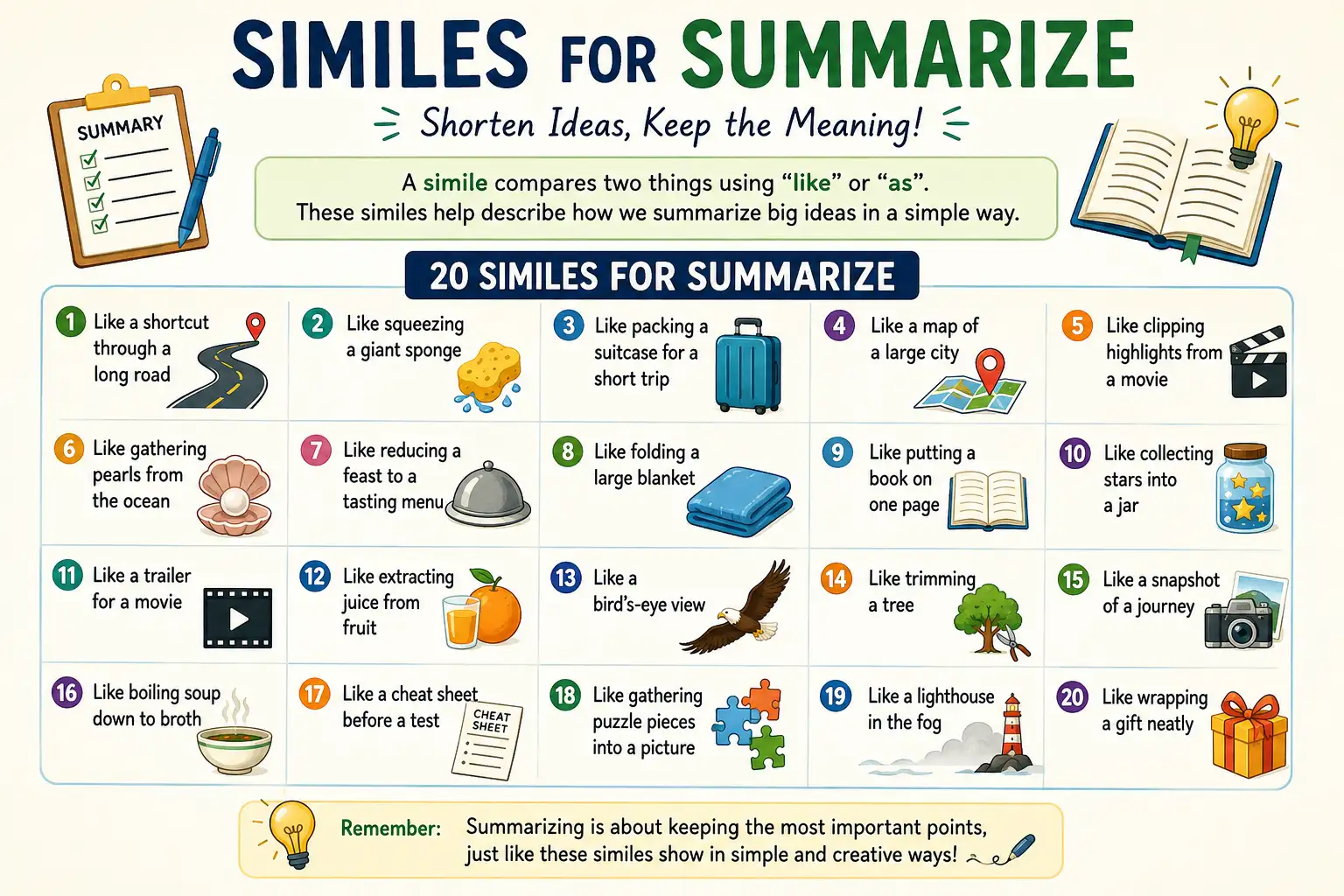
20 Similes for Summarize
1. Like a shortcut through a long road
Meaning: Getting to the main point quickly.
Explanation: A summary removes unnecessary details and leads directly to the key ideas.
Examples:
- Her summary was like a shortcut through a long road.
- The report felt like a shortcut through a complicated topic.
2. Like squeezing a giant sponge
Meaning: Condensing large amounts of information.
Explanation: Just as a sponge releases water when squeezed, a summary extracts the essential points.
Examples:
- Summarizing the novel was like squeezing a giant sponge.
- His notes were like squeezing a giant sponge full of facts.
3. Like packing a suitcase for a short trip
Meaning: Keeping only what is necessary.
Explanation: A summary includes only the most important details.
Examples:
- Writing the summary was like packing a suitcase for a short trip.
- She summarized the article like packing a suitcase efficiently.
4. Like a map of a large city
Meaning: Showing key points without every detail.
Explanation: Maps guide people without displaying everything.
Examples:
- His summary was like a map of a large city.
- The outline felt like a map of the entire discussion.
5. Like clipping highlights from a movie
Meaning: Selecting the most important moments.
Explanation: Summaries focus on major events.
Examples:
- The review was like clipping highlights from a movie.
- Her notes felt like movie highlights.
6. Like gathering pearls from the ocean
Meaning: Collecting valuable information.
Explanation: A summary keeps the best parts.
Examples:
- Summarizing the chapter was like gathering pearls from the ocean.
- His report gathered pearls from many sources.
7. Like reducing a feast to a tasting menu
Meaning: Presenting a smaller version of something large.
Explanation: Summaries provide key samples of information.
Examples:
- The summary was like reducing a feast to a tasting menu.
- Her speech condensed the topic beautifully.
8. Like folding a large blanket
Meaning: Making something big more manageable.
Explanation: Summaries organize information into a smaller form.
Examples:
- Writing the conclusion was like folding a large blanket.
- He folded the entire discussion into one paragraph.
9. Like putting a book on one page
Meaning: Compressing information greatly.
Explanation: A summary captures the essence briefly.
Examples:
- The assignment was like putting a book on one page.
- Her summary felt amazingly compact.
10. Like collecting stars into a jar
Meaning: Gathering important points together.
Explanation: Summaries bring scattered ideas into one place.
Examples:
- His notes were like collecting stars into a jar.
- The article gathered ideas neatly.
11. Like a trailer for a movie
Meaning: Giving an overview.
Explanation: Trailers show the most important parts.
Examples:
- The summary was like a trailer for a movie.
- Her introduction felt like a movie preview.
12. Like extracting juice from fruit
Meaning: Taking only the valuable parts.
Explanation: A summary removes unnecessary information.
Examples:
- Summarizing the text was like extracting juice from fruit.
- He kept only the useful details.
13. Like a bird’s-eye view
Meaning: Seeing the whole picture quickly.
Explanation: Summaries provide a broad overview.
Examples:
- The paragraph gave a bird’s-eye view of the topic.
- Her report offered a quick overview.
14. Like trimming a tree
Meaning: Removing extra parts.
Explanation: Summaries cut unnecessary information.
Examples:
- Editing the article was like trimming a tree.
- The final version looked much cleaner.
15. Like a snapshot of a journey
Meaning: Capturing the main experience.
Explanation: Summaries focus on key moments.
Examples:
- The conclusion was like a snapshot of a journey.
- His notes captured the experience perfectly.
16. Like boiling soup down to broth
Meaning: Concentrating information.
Explanation: Important points remain after reduction.
Examples:
- Summarizing was like boiling soup down to broth.
- The final report was rich and focused.
17. Like a cheat sheet before a test
Meaning: A quick review of key facts.
Explanation: Summaries provide essential information.
Examples:
- Her notes were like a cheat sheet before a test.
- The summary helped me review quickly.
18. Like gathering puzzle pieces into a picture
Meaning: Combining important elements.
Explanation: A summary creates a clear overall understanding.
Examples:
- The overview was like gathering puzzle pieces into a picture.
- His summary made everything clear.
19. Like a lighthouse in the fog
Meaning: Showing the most important direction.
Explanation: Summaries guide readers to the main idea.
Examples:
- The conclusion was like a lighthouse in the fog.
- Her summary pointed to the key message.
20. Like wrapping a gift neatly
Meaning: Presenting information clearly.
Explanation: A summary organizes ideas in an appealing way.
Examples:
- The final paragraph was like wrapping a gift neatly.
- He presented the information perfectly.
Practical Exercise Section
Questions
- Complete the simile: “The summary was like a _____ through a long road.”
- Which simile means condensing information? “Like squeezing a giant sponge” or “Like riding a bicycle”?
- What does “Like a movie trailer” suggest?
- Complete: “Summarizing was like boiling soup down to _____.”
- Which simile represents removing unnecessary details?
- What does “Like a bird’s-eye view” mean?
- Complete: “The report was like collecting stars into a _____.”
- Which simile compares summarizing to packing only essentials?
- What is the purpose of a summary?
- Which simile would best describe a quick review before an exam?
Answers with Explanations
- Shortcut – It means reaching the main point quickly.
- Like squeezing a giant sponge – It represents condensing information.
- An overview of the main points – Just like a trailer previews a movie.
- Broth – The most important part remains.
- Like trimming a tree – Extra parts are removed.
- Seeing the whole picture quickly – A broad overview.
- Jar – Gathering important ideas together.
- Like packing a suitcase for a short trip – Keeping only essentials.
- To present key information briefly – The main goal of summarizing.
- Like a cheat sheet before a test – A quick review of important points.
Short Simile for Summarize
Like a shortcut through a journey.
Simile for Summarize Example
“The teacher’s recap was like a movie trailer, showing only the most important moments.”
Best Simile for Summarize
Like squeezing a giant sponge because it clearly shows how information is condensed.
To Summarize Synonym Formal
- Condense
- Recap
- Outline
- Abstract
- Digest
- Present briefly
Summarize Synonym and Antonyms
Synonyms
- Condense
- Recap
- Simplify
- Outline
- Digest
Antonyms
- Expand
- Elaborate
- Lengthen
- Detail
- Amplify
Summarize Antonyms
- Expand
- Elaborate
- Extend
- Develop
- Enlarge
To Briefly Summarize Synonym
- In short
- To recap
- Briefly stated
- In summary
- To put it simply
To Summarize in a Sentence
“To summarize means to express the main points of something in a shorter and clearer form.”
Similes for Summarize in Essays and Reports
Essays and reports often end with a summary, and a fresh simile can make that closing paragraph feel polished rather than flat. The two comparisons below suit formal writing, because they describe careful work rather than speed alone. Use one near the end of an essay, just before the final point, so the reader feels the whole argument gathering into one clear idea.
Like distilling a river into a glass of water. Meaning: Turning a wide flow of facts into one small, clear drink of truth. Explanation: A river carries far more water than anyone can drink, yet a single glass can hold its cleanest part. In the same way, a good summary keeps only the clearest facts. Examples: Her essay ended like distilling a river into a glass of water, with every extra detail left behind. The report distilled a river of data into a glass of clear findings.
Like a telegram that carries only the news that matters. Meaning: Sending the essential message without extra words. Explanation: A telegram charged by the word, so every word had to earn its place. A summary works the same way, keeping only the news the reader truly needs. Examples: His recap read like a telegram that carries only the news that matters. She trimmed the chapter like a telegram, short, sharp, and complete.
Similes for Summarize in Everyday Talk
In everyday talk, a summary should sound natural, not academic. These two images fit conversations, messages, and quick explanations, because they use objects everyone knows.
Like a seed that holds a whole tree. Meaning: A tiny form that contains a much larger idea. Explanation: A seed looks small, yet it holds the pattern of a full tree inside it. A short summary can work the same way, holding the shape of a long story in a few lines. Examples: Her message was like a seed that holds a whole tree, small, yet full of meaning. He gave me the seed of the story, and I understood the whole plot.
Like a key that opens a long story. Meaning: One short phrase that unlocks the whole meaning. Explanation: A key is small, but it opens a large door. A good summary gives the listener the key first, so the rest of the story makes sense at once. Examples: Her opening line worked like a key that opens a long story. He handed me the key to the meeting in a single sentence.
Try one of these images the next time you sum up a book, a film, or a long day. Say the simile, then give the summary itself in one or two short sentences. The image earns attention, and the short summary rewards it.
FAQs:
What is a simile?
A simile is a comparison using “like” or “as” to help describe something more clearly.
Why are similes useful in writing?
They make descriptions more vivid, engaging, and easier to understand.
Can similes be used in academic writing?
Yes, but they should be used carefully and only when appropriate.
What is the best simile for summarize?
“Like squeezing a giant sponge” is one of the most effective because it shows condensation of information.
How do I create my own simile?
Compare your idea to something familiar using “like” or “as.”
What is the difference between a simile and a metaphor?
A simile uses “like” or “as,” while a metaphor makes a direct comparison.
Similes for Summarize in Classroom Discussions
Classroom discussions move fast, and a student who can sum up the point clearly stands out. A simile for summarize helps the class picture the job of condensing a long talk into one clear idea.
- To summarize is like packing a suitcase: To summarize is like packing a suitcase, keeping only what you need for the trip.
- To summarize is like squeezing juice from fruit: To summarize is like squeezing juice from fruit, pressing a long text down to its sweetest part.
- To summarize is like drawing a map of a long road: To summarize is like drawing a map of a long road, showing the turns without every stone.
- To summarize is like taking a photo of a wide view: To summarize is like taking a photo of a wide view, catching the whole scene in one frame.
- To summarize is like telling a friend the short version: To summarize is like telling a friend the short version, quick, clear, and honest.
Short Similes for Summarize for Quick Notes
Quick notes need quick images. A short simile for summarize can sit at the top of a page and remind you what to do with a long chapter. Keep it to one line so it works as a memory aid.
- To summarize is like boiling soup down: To summarize is like boiling soup down, less liquid, more flavour.
- To summarize is like folding a big map: To summarize is like folding a big map, smaller to carry, same places inside.
- To summarize is like trimming a long story: To summarize is like trimming a long story, cutting the extra words, keeping the plot.
- To summarize is like catching the chorus: To summarize is like catching the chorus, the part everyone remembers.
- To summarize is like writing on a postcard: To summarize is like writing on a postcard, little space, so only the best lines survive.
Similes for Summarize in Business and Work
In offices and meetings, a good summary saves time, and a simile can explain that value in one line. To summarize is like writing a headline for a long report, because the headline must carry the whole story in a few words. To summarize is like drawing a map of a long road, because the map keeps only the turns that matter and leaves out every side street. To summarize is like packing a suitcase for a short trip, because only the most useful items earn a place inside.
These work images help in emails and presentations, where busy readers want the point fast. A manager who says that a summary is like a map tells the team exactly what to expect. Keep the business simile short, then give the summary itself, so the image introduces the point instead of replacing it.
Similes for Summarize for Students
Students summarize every day, in revision notes, exam answers, and class discussions, and a vivid simile makes the skill easier to remember. To summarize is like squeezing juice from a whole basket of fruit, because pages of notes become a single glass of main points. To summarize is like a trailer for a long film, because the trailer shows the best scenes without telling the whole plot. To summarize is like writing notes on a small card, because the small space forces the writer to keep only what truly matters.
Teachers can use these images to show students what a summary is not. A summary is not a copy of the whole chapter, just as juice is not the whole basket. When students test their summary by asking whether a classmate could understand the topic from the short version alone, they learn quickly whether they kept the right points.
Conclusion
Now you know several creative ways to describe the idea of summarizing through similes. If you use phrases like “like a shortcut through a long road” or “like squeezing a giant sponge,” these comparisons help make your writing more vivid and memorable.
Similes are powerful tools because they turn simple explanations into clear mental pictures.
As you continue practicing creative writing similes, try creating your own comparisons for everyday actions and ideas.
The more examples of similes you explore, the easier it becomes to understand their meaning and use them naturally. Start experimenting today, and you’ll soon discover how much more engaging your writing can become.

Hi, I’m Ethan Caldwell. I enjoy writing simple and creative similes. I help readers express feelings like love and happiness in easy words on Similisticez.com.