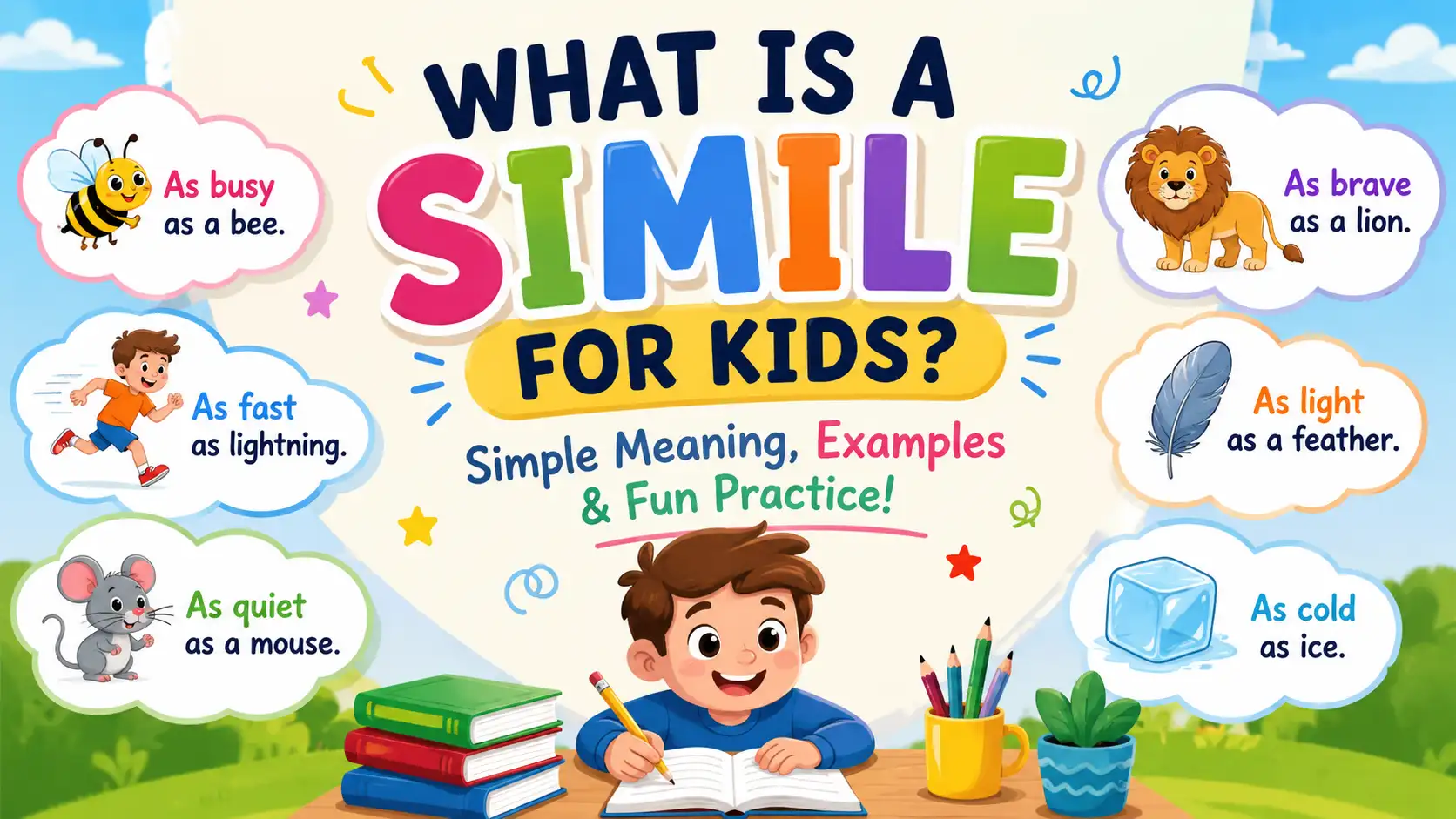
What Is a Simile for Kids: Simple Definition With 60 Fun Examples (2026)
A simile is a fun way of describing something by comparing it to something else, using the words like or as. When you say someone is as brave as a lion, you are not saying they are an actual lion. You are saying their bravery reminds you of a lion. Similes make writing more exciting because they paint pictures in the reader’s mind. This guide explains what a simile is in simple words, shows you how to spot one, gives you 60 fun examples, and teaches you how to write your own. Perfect for homework, class activities, and young writers everywhere.
What Is a Simile? The Simple Definition
A simile is a comparison between two different things that uses the word like or as. The two things are different, but they share one quality. For example, in the sentence her smile was as bright as the sun, a smile and the sun are very different things, but both can be bright. That shared quality is what makes the simile work. Remember the simple rule. If you see like or as joining two different things in a comparison, you have probably found a simile. Similes are different from metaphors, which compare things without using like or as. Saying he is a lion is a metaphor. Saying he is as brave as a lion is a simile.
How to Spot a Simile in 3 Easy Steps
First, look for the words like or as in the sentence. Second, check that the sentence is comparing two different things, not just describing one thing. Third, ask what quality they share. In the sentence the classroom was as quiet as a library, the words as quiet as a library signal the simile, a classroom and a library are the two different things, and the shared quality is quietness. Practice these three steps with the examples below and you will be spotting similes like a detective in no time.
60 Fun Simile Examples for Kids
Animal Similes
As brave as a lion. This means very brave, because lions are known for courage.
As busy as a bee. This means working hard without stopping.
As quiet as a mouse. This means making almost no sound at all.
As slow as a turtle. This means moving very, very slowly.
As wise as an owl. This means smart and thoughtful.
As playful as a puppy. This means full of fun energy.
As stubborn as a mule. This means refusing to change your mind.
As graceful as a swan. This means moving beautifully and smoothly.
As quick as a bunny. This means fast and bouncy.
As strong as an ox. This means very powerful.
As sly as a fox. This means clever in a tricky way.
As gentle as a lamb. This means soft and kind.
Food Similes
As sweet as candy. This means very sweet and pleasant.
As cool as a cucumber. This means calm even in a tough spot.
As easy as pie. This means super simple to do.
As sour as a lemon. This means grumpy or unpleasant.
As warm as fresh bread. This means comforting and cozy.
As nutty as a fruitcake. This is a funny way to say silly.
As flat as a pancake. This means completely flat.
As red as a cherry. This means bright red, often from blushing.
As fresh as a daisy. This means full of energy and new.
As tough as old beef jerky. This is a funny way to say very tough.
Nature Similes
As bright as the sun. This means shining with light or happiness.
As tall as a tree. This means very tall.
As free as a bird. This means able to go anywhere.
As deep as the ocean. This means very deep, in feeling or thought.
As fast as lightning. This means incredibly quick.
As white as snow. This means pure white.
As gentle as rain. This means soft and calm.
As wild as a storm. This means full of crazy energy.
As round as the moon. This means perfectly round.
As green as grass. This means bright green.
Everyday Object Similes
As light as a feather. This means weighing almost nothing.
As hard as a rock. This means very solid and tough.
As sharp as a tack. This means very smart.
As smooth as silk. This means perfectly smooth.
As clear as glass. This means easy to see or understand.
As busy as a one armed paper hanger. This is a funny old saying about being super busy.
As snug as a bug in a rug. This means cozy and comfortable.
As straight as an arrow. This means honest and direct.
As old as the hills. This means extremely old.
As proud as a peacock. This means showing off a little.
Funny Similes Kids Love
Like a penguin in a tuxedo. This is a silly way to describe someone dressed up.
Like a fish out of water. This means feeling out of place.
Like a bull in a china shop. This means clumsy in a careful place.
Like a kid in a candy store. This means super excited about choices.
As happy as a clam. This is a classic funny way to say very happy.
Like spaghetti in a tornado. This is a silly image for total chaos.
As grumpy as a cat in a bathtub. This is a hilarious way to say very grumpy.
Like a marshmallow in hot chocolate. This is a cozy way to say soft and melting.
Like a dragon guarding treasure. This is a fun way to describe someone very protective.
As sparkly as a unicorn horn. This is a magical way to say glittery and special.
Like a superhero landing. This is a cool way to describe a dramatic entrance.
As fluffy as a cloud shaped like a dinosaur. This is a dreamy way to say wonderfully soft and fun.
Like a robot learning to dance. This is a hilarious image for stiff, jerky movements.
How to Write Your Own Similes
Writing your own simile is easy and fun. Start with the thing you want to describe, like your dog. Then think of something completely different that shares one quality with it. If your dog is fast, you might think of a race car. Then join them with like or as. My dog runs like a race car. That is a simile you invented. Try this formula. First pick your subject. Then pick the quality, fast, funny, loud, soft. Then brainstorm wild comparisons and pick the funniest or clearest one. The sillier the comparison, the more memorable your simile will be.
Common Mistakes Kids Make With Similes
The most common mistake is comparing two things that are too similar. Saying my dog is like your dog is not a simile, it is just a plain comparison. A simile needs two different things. Another mistake is forgetting the shared quality. If you say he eats like a horse, make sure the reader understands you mean he eats a lot. Kids also sometimes use like when they mean they enjoy something. Saying I like pizza is not a simile. A simile needs a full comparison, like my love for pizza is as big as the moon.
A simile is a fun way of describing something by comparing it to something else, using the words like or as. When you say someone is as brave as a lion, you are not saying they are an actual lion. You are saying their bravery reminds you of a lion. Similes make writing more exciting because they paint pictures in the reader’s mind.
This guide explains what a simile is in simple words, shows you how to spot one in three easy steps, gives you 75 fun examples, includes a practice quiz with an answer key, and teaches you how to write your own. It is perfect for homework, class activities, and young writers everywhere.
How to Spot a Simile in 3 Easy Steps
First, look for the words like or as in the sentence. Second, check that the sentence is comparing two different things, not just describing one thing. Third, ask what quality they share.
Let us try it together with this sentence: the classroom was as quiet as a library. Step one, we see the words as quiet as, which is our signal. Step two, we find the two different things: a classroom and a library. Step three, we ask what they share, and the answer is quietness. Practice these three steps with the examples below and you will be spotting similes like a detective in no time.
Simile Practice Quiz for Kids
Try this mini worksheet. Write your answers on paper, then check the answer key at the end.
Part A: Fill in the Blanks
1. The soldier was as brave as a ______.
2. The package was as light as a ______.
3. After the race, his legs felt like ______.
4. The night was as dark as ______.
5. She swims like a ______.
6. The new teacher is as sweet as ______.
Part B: Multiple Choice
7. The water in the lake was as clear as ______. A) mud B) crystal C) night
8. The joke is as old as the ______. A) hills B) newspaper C) bread
9. The two friends are as different as night and ______. A) moon B) day C) dark
10. Without any rain, the ground was as dry as a ______. A) bone B) river C) sponge
11. The baby laughed like ______. A) thunder B) music C) a foghorn
12. Which sentence contains a simile? A) I like pizza. B) My dog runs like the wind. C) The cat is sleeping.
Answer Key
Part A: 1) lion 2) feather 3) jelly 4) coal 5) fish 6) sugar. Part B: 7) B, 8) A, 9) B, 10) A, 11) B, 12) B.
How to Write Your Own Similes
Writing your own simile is easy and fun. Follow this four step builder:
- Step 1: Pick your subject. Start with the thing you want to describe, like your dog, your teacher, or a rainy day.
- Step 2: Pick the quality. Choose what you want to describe about it: fast, funny, loud, soft, scary, or cozy.
- Step 3: Brainstorm a wild comparison. Think of something completely different that shares that quality. If your dog is fast, you might think of a race car.
- Step 4: Join them with like or as. My dog runs like a race car. That is a simile you invented.
Try this formula. First pick your subject. Then pick the quality, fast, funny, loud, soft. Then brainstorm wild comparisons and pick the funniest or clearest one. The sillier the comparison, the more memorable your simile will be. You can also start sentences with these frames: as ______ as a ______ or ______ like a ______.
Animal Similes for Kids to Try at Home
Animals make similes easy for kids, because children already know how animals move and sound. Try these at home, act them out, and let kids invent their own animal comparisons after.
- As busy as a bee: You worked as busy as a bee on your puzzle today.
- As slow as a snail: The snail moved as slow as a snail across the garden path.
- As brave as a lion: She felt as brave as a lion when she tried the big slide.
- As quiet as a mouse: He crept as quiet as a mouse past the sleeping dog.
- As happy as a puppy with a new ball: He jumped as happy as a puppy with a new ball.
Food Similes for Kids That Make Learning Fun
Food similes turn a lesson into a snack time game. Kids remember tastes and smells easily, so comparing feelings to foods helps the idea stick. Use these in class or at the kitchen table.
- As sweet as honey: Her kind words were as sweet as honey on toast.
- As cool as ice cream: He stayed as cool as ice cream on a hot day.
- As round as a pancake: The moon looked as round as a pancake in the sky.
- As soft as jelly: The kitten felt as soft as jelly in her hands.
- As sour as a lemon: His face went as sour as a lemon when he lost the game.
Simile Treasure Hunt: Finding Comparisons in Everyday Talk
Similes hide in everyday talk far more often than children expect, and hunting for them turns listening into a game. Ask children to listen during breakfast, on the school run, or during a favourite show, and to catch every comparison they hear. Grown ups say things like busy as a bee, quiet as a mouse, or cool as a cucumber without even noticing, and each one is a simile waiting to be spotted. A child who catches five in a day has learned more than any worksheet could teach.
Keep a family simile jar for the hunt. Write each spotted simile on a slip of paper, drop it in the jar, and read the collection together at the end of the week. Talk about which ones are funny, which ones are beautiful, and which ones feel old fashioned. Children quickly learn that similes are not just schoolwork, they are part of how people actually speak, joke, and comfort each other.
For a harder hunt, ask children to catch similes that describe feelings rather than looks. As happy as a clam, as nervous as a cat, as proud as a peacock, each one turns an invisible feeling into a picture. Feeling similes help children name their own emotions too, because comparing a feeling to something familiar makes it easier to talk about. A child who can say, I feel like a fish out of water, has already explained a complicated feeling in six simple words.
How Teachers Can Turn Similes Into a Classroom Game
Teachers can turn simile practice into a game the whole class enjoys with very little preparation. Write the first half of a simile on the board, such as as brave as, and let students shout completions. Accept every sensible answer, then discuss which ones paint the clearest picture. The class quickly learns that brave as a lion and brave as a firefighter both work, but they create different feelings, and choosing between them is real writing skill.
Another easy game is simile bingo. Give each student a card with comparison words such as bee, lion, feather, rock, and storm, and read example sentences aloud. Students mark the word when they hear it in a simile, and the first full row wins. Bingo forces careful listening, because students must check whether like or as is really comparing two things, or merely describing a job or a preference.
Finish the lesson with a simile chain story. One student starts a story with a simile, the next student continues it with a different simile, and so on around the room. The story becomes gloriously silly, which is exactly the point: children who laugh while learning remember the lesson. Collect the best lines on a classroom wall, and the class will have built its own simile guide without realising it.
Frequently Asked Questions
Can similes describe feelings?
Yes, similes describe feelings beautifully. As happy as a clam or as nervous as a kitten turns an invisible feeling into a picture everyone can understand at once.
Is every sentence with like a simile?
No, like must be comparing two different things. I like pizza is an opinion, not a simile, because nothing is being compared to anything else.
What is a simile for excitement?
Like a kid in a candy store is a classic excitement simile. It pictures wide eyes, fast movement, and delight at having too many wonderful choices at once.
How can kids practise similes without homework?
Play spotting games during meals, car rides, or story time. Catching similes in songs, shows, and family talk practises the skill naturally, with no worksheet needed.
Conclusion
A simile is simply a comparison that uses like or as to paint a picture in words. Now you know the simple definition, the three steps to spot a simile, 75 fun examples across animals, food, nature, and more, and a four step builder to write your own.
Keep practicing with the quiz above, try inventing one new simile every day, and watch your writing get brighter and more fun. Before long, you will be spotting similes everywhere, in books, songs, and everyday talk.
Frequently Asked Questions
What is a simile in simple words?
A simile is a comparison that uses like or as to describe something by comparing it to something different, like saying someone is as brave as a lion.
What is an example of a simile for kids?
As busy as a bee is a perfect example. It compares a busy person to a bee using the word as, and kids instantly understand it.
What is the difference between a simile and a metaphor?
A simile uses like or as, while a metaphor does not. He is as brave as a lion is a simile. He is a lion is a metaphor.
Can a simile use the word like more than once?
Yes. You can say she swims like a fish and runs like the wind in the same sentence. Each comparison with like or as counts as a simile.
How many similes should I use in my story?
Use two or three strong similes in a short story. Too many comparisons can distract the reader from your actual tale.

Learn simple and creative similes with Mason Reid at similisticez.com to improve writing skills with easy examples and explanations.