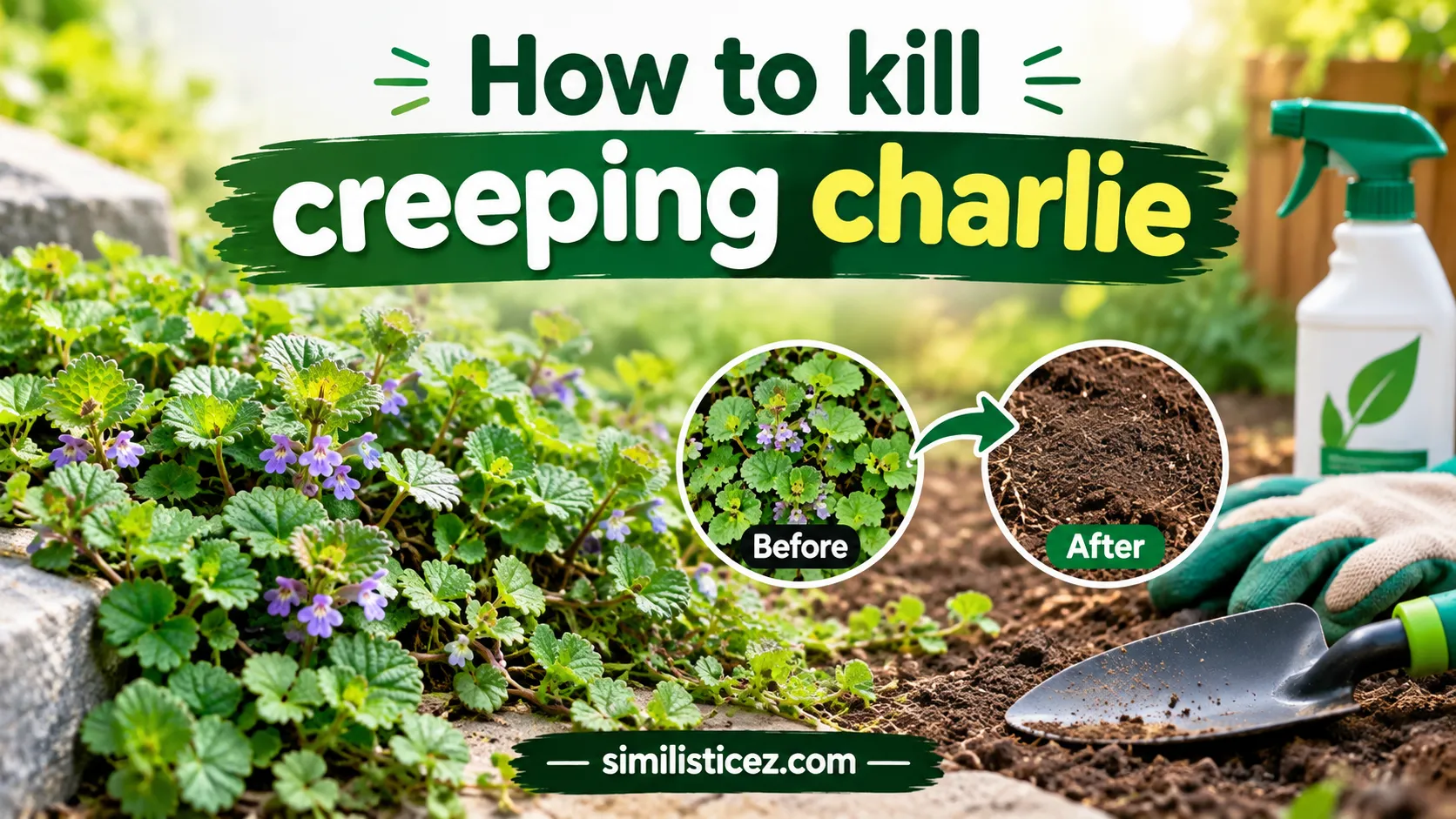
The first time I noticed creeping Charlie spreading across a lawn, I honestly thought it was just another small ground-cover plant.
Within a short time, though, those little vines seemed to be everywhere. They spread along the soil, pushed into garden beds, and became difficult to remove by hand.
If you are dealing with the same problem, you are probably wondering how to kill creeping Charlie without damaging the grass or nearby plants.
Quick Answer:
The best way to kill creeping Charlie is to combine hand removal, lawn-care improvements, and, when necessary, a selective broadleaf herbicide labeled for creeping Charlie.
Persistence is important because its creeping stems can root at multiple points.
🧠 What Is Creeping Charlie?
Creeping Charlie, also called ground ivy, is a low-growing perennial weed that spreads through creeping stems. Its scientific name is Glechoma hederacea. It can form dense patches in lawns, shady areas, and garden beds.
The plant often has rounded or kidney-shaped leaves with scalloped edges. It may also produce small purple or bluish flowers.
Creeping Charlie is particularly troublesome because its stems can spread across the ground and root at different points. Simply pulling out the visible leaves may not always eliminate the entire plant.
In short: Creeping Charlie = ground ivy = a spreading perennial lawn and garden weed.
📱 Where Does Creeping Charlie Commonly Grow?
Creeping Charlie can appear in several places around a property, especially where growing conditions favor it.
- 🌳 Shady lawns: It often thrives where grass receives limited sunlight.
- 💧 Moist soil: Damp areas can encourage vigorous growth.
- 🌱 Thin grass: Bare or weak lawn areas give creeping Charlie room to spread.
- 🌿 Garden borders: Its vines can move from lawns into planting beds.
- 🏡 Under trees: Reduced sunlight and competition from tree roots can create favorable conditions.
Creeping Charlie is not usually a problem because of one isolated plant. The bigger issue is its ability to spread and create a dense mat over time.
💬 Examples of How People Deal With Creeping Charlie
Here are some realistic situations gardeners commonly face:
A: “why is this vine taking over my lawn? 😩”
B: “it looks like creeping Charlie. you may need to remove it and treat the lawn.”
A: “can i just pull creeping Charlie out?”
B: “you can, especially in small areas, but make sure you remove as much of the rooted stem as possible.”
A: “creeping Charlie is growing under my tree 🌳”
B: “that shady spot may be helping it spread.”
A: “my lawn has huge patches of ground ivy.”
B: “improving the grass density can help prevent it from coming back.”
A: “what kills creeping Charlie?”
B: “hand removal can work for small patches, while a suitable broadleaf weed treatment may help with larger infestations.”
A: “i removed it last month and it came back 😭”
B: “that can happen. creeping Charlie can regrow from pieces of stem, so follow-up removal is important.”
🕓 When to Use and When Not to Use Different Removal Methods
✅ When to Use Hand Removal
Hand-pulling is useful when:
- The infestation is small.
- Creeping Charlie is growing near desirable plants.
- You want to avoid herbicides.
- The soil is loose enough to remove rooted stems.
- You can regularly inspect the area for regrowth.
Try to remove the stems and roots rather than simply breaking off the leaves.
❌ When Hand Removal May Not Be Enough
Manual removal can become frustrating when:
- A large section of lawn is affected.
- The weed has formed a thick mat.
- Stems have rooted across a wide area.
- Pieces are left behind and begin growing again.
For larger infestations, an integrated approach is usually more practical.
Comparison Table
| Situation | Best Approach | Why It Works |
| Small garden patch | Hand removal | Gives precise control |
| Creeping Charlie near flowers | Careful hand removal | Protects desirable plants |
| Large lawn infestation | Lawn improvement + suitable weed control | Addresses widespread growth |
| Thin, weak lawn | Improve grass density | Reduces space for weeds |
| Shady area | Improve growing conditions where practical | Makes the area less favorable for weeds |
🌱 How to Kill Creeping Charlie Naturally
If you prefer to avoid chemical weed killers, start with physical removal and prevention.
1. Pull the Plant Carefully
Choose a time when the soil is slightly moist. Pull the creeping stems gently and try to remove rooted sections rather than breaking them apart.
2. Remove Leftover Pieces
Do not leave removed stems lying in a moist garden area. Check the soil for pieces that may still contain viable nodes.
3. Improve the Lawn
A thick, healthy lawn leaves less room for creeping Charlie. Address problems such as bare patches, poor mowing practices, inadequate lawn care, or unsuitable grass conditions.
4. Improve Drainage When Appropriate
If an area remains unnecessarily wet, correcting drainage problems may make the environment less favorable for creeping Charlie.
5. Monitor the Area
Check treated areas regularly. Early removal of new growth is much easier than dealing with another large patch.
🧴 How to Kill Creeping Charlie With Herbicide
For widespread lawn infestations, a selective broadleaf herbicide labeled for creeping Charlie may be an option.
Always read and follow the product label. Different products have different active ingredients, application rates, temperature restrictions, lawn restrictions, and safety requirements.
A few important points:
- 🌿 Choose a product specifically labeled for creeping Charlie or ground ivy.
- 📋 Follow the label directions exactly.
- 🌱 Make sure the product is safe for your particular grass species.
- 🌧️ Pay attention to rainfall and watering instructions.
- 🐝 Follow precautions concerning pets, children, pollinators, and nearby plants.
- 🔁 Some infestations may require follow-up treatment according to the product label.
Avoid randomly mixing weed killers or increasing the recommended concentration. More product does not necessarily mean better control and can increase the risk of lawn or environmental damage.
🔄 Similar Weeds That Can Be Confused With Creeping Charlie
Several low-growing plants can look similar at first glance.
| Weed or Plant | General Appearance | Key Difference |
| Creeping Charlie | Rounded leaves and creeping stems | Often has scalloped leaves and small purple flowers |
| White clover | Three-part leaves | Typically has distinctive three-leaf clusters |
| Creeping thyme | Low-growing and spreading | Leaves and growth habit differ from ground ivy |
| Creeping buttercup | Spreading stems | Usually has yellow flowers |
| Henbit | Upright or spreading growth | Leaves and flowers differ from creeping Charlie |
Correct identification matters because the best control method depends on the plant you actually have.
❓ FAQs
1. What is the fastest way to kill creeping Charlie?
For a small infestation, careful removal can provide quick visible results. Larger infestations may require a suitable labeled herbicide and follow-up control.
2. Can I kill creeping Charlie without chemicals?
Yes. Small patches can often be managed through persistent hand removal and better lawn or garden conditions.
3. Why does creeping Charlie keep coming back?
It can regrow from creeping stems and rooted sections that remain in the soil.
4. Is creeping Charlie difficult to remove?
Large, established infestations can be difficult because the plant spreads horizontally and can root along its stems.
5. Does mowing kill creeping Charlie?
Mowing may remove visible growth but usually does not eliminate an established infestation because the plant can continue growing from its stems and roots.
6. Will vinegar kill creeping Charlie?
Household vinegar can damage plant tissue, but it is not necessarily a reliable solution for eliminating an established creeping Charlie infestation. It can also damage desirable plants.
7. Can I pull creeping Charlie by hand?
Yes. Hand removal is particularly useful for small patches or areas close to plants you want to protect.
8. Should I remove creeping Charlie before it flowers?
Removing it before it becomes more established can make management easier. Regular monitoring is more important than waiting for a particular stage.
9. Does creeping Charlie grow in shade?
Yes. It commonly performs well in shady conditions, particularly where soil conditions also favor its growth.
10. Does a healthy lawn help prevent creeping Charlie?
A dense, healthy lawn can reduce opportunities for weeds to establish by occupying available growing space.
11. Can creeping Charlie grow in garden beds?
Yes. Its creeping stems can spread from lawns and other areas into garden beds.
12. Can mulch stop creeping Charlie?
A suitable layer of mulch can help suppress some weeds, although established creeping Charlie may continue growing through or around it.
13. Can I compost creeping Charlie?
Be cautious. Avoid composting plant material if your compost system does not reliably destroy viable plant pieces.
14. Is creeping Charlie poisonous?
Avoid assuming a plant is safe to eat simply because it is common. Keep unidentified plant material away from children and pets.
15. Can creeping Charlie damage my lawn?
It can compete with turfgrass and form dense patches, particularly when lawn conditions are favorable to the weed.
16. Should I remove creeping Charlie roots?
Yes. When manually removing it, try to remove rooted sections and creeping stems rather than only cutting off the leaves.
17. Does fertilizing the lawn kill creeping Charlie?
Fertilizer itself is not a direct creeping Charlie killer. Proper lawn nutrition can support stronger turf, which may help reduce opportunities for weeds.
18. Can I prevent creeping Charlie completely?
Complete prevention can be difficult, but regular monitoring, strong turf, appropriate watering, and early removal can reduce its spread.
19. What should I do after removing creeping Charlie?
Inspect the area regularly for regrowth and improve the conditions that allowed the weed to establish.
20. What is the most important thing to remember?
Do not expect one quick treatment to solve every infestation. Persistent monitoring and the right control method for the situation are key.
Conclusion
Getting rid of creeping Charlie can take some patience, but it is definitely manageable. For small patches, carefully pulling the plant and removing rooted stems can be effective.
Larger infestations may need a combination of proper lawn care and a suitable herbicide labeled for creeping Charlie.
The key is to keep checking the area after treatment and remove new growth before it spreads again. A thick, healthy lawn can also make it harder for creeping Charlie to take over.
With consistent care and the right method, you can gradually clear creeping Charlie and keep your lawn looking healthier and cleaner.