How Long Does Botox Take to Work: Day by Day Timeline and Early Signs (2026)
Have you ever had Botox and then looked in the mirror the next morning wondering, “Is this supposed to be working already?”
I remember how confusing it can feel when you expect an instant change but your face looks almost the same after the appointment.
The truth is that Botox does not usually work immediately. It gradually affects the targeted muscles, so you may notice small changes before seeing the final result.
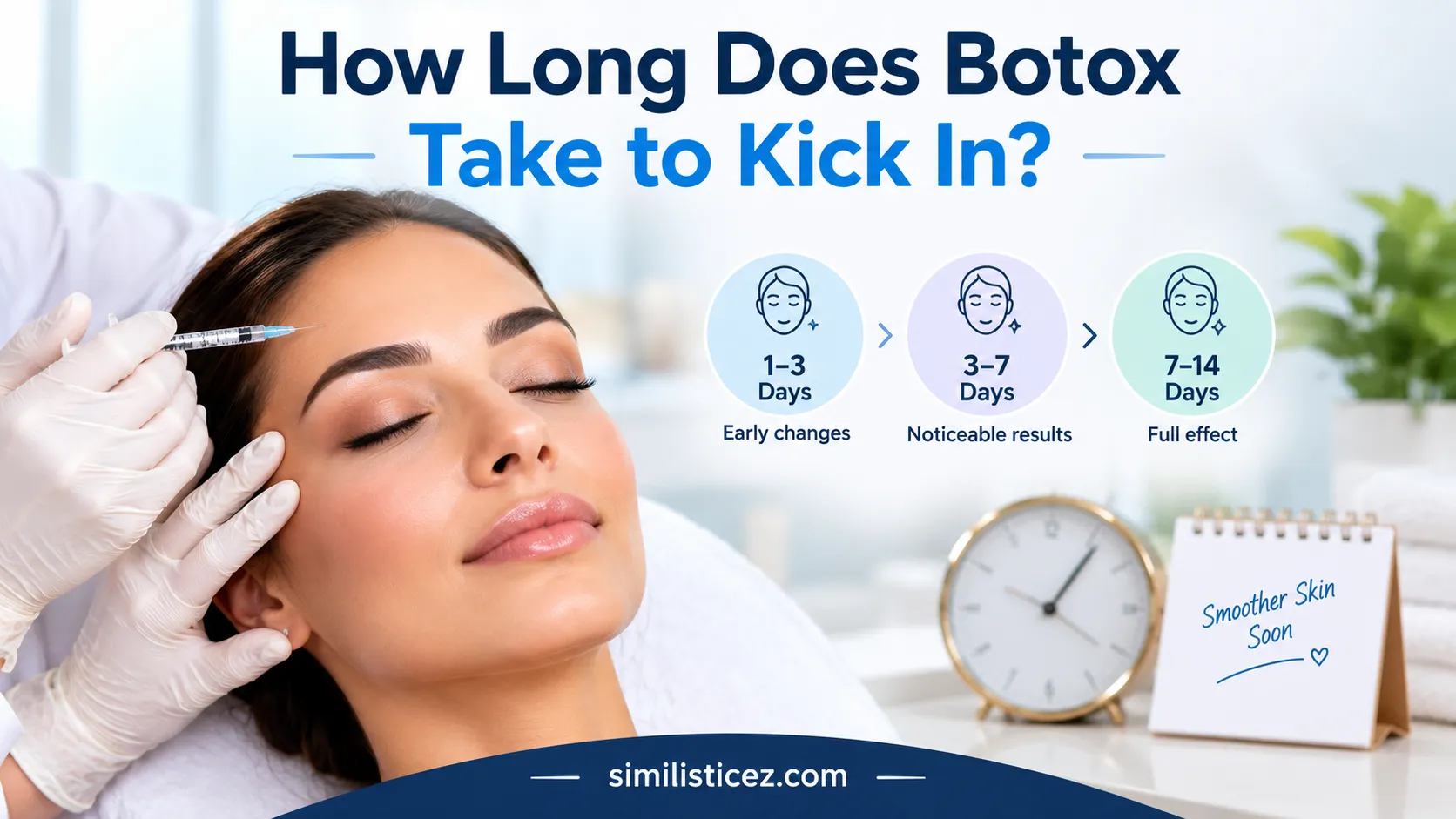
For cosmetic Botox, some people begin noticing effects within 1–2 days, while the full result can take longer depending on the treatment area.
Quick Answer:
Botox can start showing results within 1–2 days, although noticeable improvement commonly develops over several days. Full results depend on the area treated and may take up to several weeks.
🧠 What Does “How Long Does Botox Take to Kick In?” Mean?
The question “how long does Botox take to kick in?” simply asks how long you need to wait before Botox begins producing its intended effect.
Botox works by temporarily blocking nerve signals to targeted muscles. When those muscles relax, certain wrinkles can appear softer and less noticeable. Because this process happens gradually, you should not expect your face to look completely different immediately after your appointment.
For BOTOX Cosmetic, the manufacturer says you may begin seeing results in 1–2 days for forehead lines, frown lines and crow’s feet, with full results listed at 30 days. For vertical neck bands, full results may take about 14 days.
In short: How long does Botox take to kick in? = Usually within a few days, with final results depending on the treatment area.
Why Doesn’t Botox Work Immediately?
Botox has to interact with the nerve endings supplying the treated muscles. That means the effect builds gradually instead of appearing instantly.
You might notice that a muscle feels slightly more relaxed before you can clearly see a cosmetic difference. This is normal and does not necessarily mean the treatment has failed.
📱 Where Is “How Long Does Botox Take to Kick In?” Commonly Used?
This question is common across health, beauty and social-media conversations rather than being a traditional texting abbreviation.
- 💬 Texting: People may ask friends about their Botox experiences.
- 📸 Instagram: Users often discuss when they noticed their cosmetic results.
- 🎵 TikTok: Beauty creators frequently talk about Botox timelines and aftercare.
- 💻 Google searches: People commonly search this question after receiving injections.
- 🩺 Provider conversations: Patients may ask their injector when they should expect results.
The phrase is informal and conversational, but the subject itself is medical and cosmetic. It can be used casually with friends, while a more professional version would be, “When should I expect the effects of Botox to become noticeable?”
💬 Examples of “How Long Does Botox Take to Kick In?” in Conversation
Here are realistic ways someone might ask about Botox in everyday conversations:
A: “i got botox yesterday and literally see no difference 😭”
B: “give it a few days. how long does botox take to kick in?”
A: “when did yours start working?”
B: “i noticed a little change after a couple days.”
A: “is it normal for my forehead to still move?”
B: “probably, it can take some time to fully settle.”
A: “thinking about getting botox before my vacation 👀”
B: “don’t leave it until the last minute. ask your provider about the timeline.”
A: “day 2 and nothing has changed lol”
B: “that doesn’t necessarily mean anything is wrong 😂”
A: “how long until botox fully kicks in?”
B: “it depends on the area, but full results can take longer than the first few days.”
A: “should i be worried that i don’t see results yet?”
B: “i’d check with your injector if you’re concerned, especially if you’re outside the expected timeline.”
🕓 When to Expect Botox to Kick In
The timeline can vary based on why you received Botox and where it was injected.
⏱️ Cosmetic Botox Timeline
For common cosmetic areas such as forehead lines, frown lines and crow’s feet, BOTOX Cosmetic says results may begin appearing within 1–2 days. Full results are listed at 30 days for these areas.
Cleveland Clinic gives a somewhat different practical timeline, noting that most people notice desired effects around the third or fourth day, with full results within 10–14 days.
These differences show why there isn’t one exact number of hours that applies to everyone.
💧 Botox for Sweating
Botox used to reduce excessive sweating can behave somewhat differently. Cleveland Clinic notes that improvement in sweating may occur within about 24 hours, while the full effect can take roughly one to two weeks.
🧠 Botox for Migraines
When Botox is used for chronic migraines, the timeline is different again. Cleveland Clinic states that people may feel the effects after one to two weeks, and some patients need multiple treatment cycles to achieve the desired benefit.
✅ When To Use This Question
Ask this question when:
- You recently received Botox and want to understand the normal timeline.
- You are planning your first treatment.
- You want to schedule Botox before an important event.
- You are comparing cosmetic and medical Botox treatments.
- You want to know when it makes sense to follow up with your provider.
❌ When Not To Rely on General Timelines
Don’t use an internet timeline as a substitute for your provider when:
- Your symptoms are severe or unusual.
- You have significant difficulty swallowing or breathing.
- You develop vision problems.
- You experience unusual weakness away from the injection area.
- You are worried that something went wrong during treatment.
Serious complications are uncommon, but symptoms such as trouble swallowing, breathing difficulty, slurred speech, vision problems or widespread weakness require prompt medical attention.
| Context | Example Phrase | Why It Works |
|---|---|---|
| Friend Chat | “how long did your botox take to kick in?” | Casual and natural |
| Beauty Discussion | “when did you start seeing results?” | Clear and specific |
| Work Chat | “When should I expect the treatment effects?” | More professional |
| “Could you please tell me when I should expect results?” | Formal and clear | |
| Provider Visit | “When should I schedule a follow-up?” | Appropriate for medical discussion |
🔄 Similar Questions and Alternatives
| Question | Meaning | When to Use |
|---|---|---|
| When does Botox start working? | Asks when effects begin | General questions |
| How long until Botox works? | Asks about the expected timeline | Casual conversations |
| When will I see Botox results? | Focuses on visible changes | Cosmetic treatments |
| How long does Botox take to work? | Directly asks about onset | Medical or beauty discussions |
| When does Botox kick in? | Informal version | Texting and casual chats |
| When will Botox fully work? | Focuses on maximum or final effect | Follow-up questions |
Have you ever had Botox and then looked in the mirror the next morning wondering, is this supposed to be working already?
I remember how confusing it can feel when you expect an instant change but your face looks almost the same after the appointment. The truth is that Botox does not usually work immediately. It gradually affects the targeted muscles, so you may notice small changes before seeing the final result.
For cosmetic Botox, most people begin noticing effects around day 3 to 5, with full results arriving by day 10 to 14.
Quick Answer: How long does Botox take to work? First softening usually appears on day 3 to 5, changes become clearly noticeable around day 7 to 10, and full results settle in by day 10 to 14.
Day-by-Day Botox Timeline
Here is what most people experience after cosmetic Botox for common areas such as forehead lines, frown lines, and crow’s feet:
Day 1: Nothing Visible Yet
On the first day, your face looks the same as before the appointment. You may have tiny injection marks or mild redness, which is normal. The product has only just been placed and has not started affecting the muscles.
Days 2 to 3: Still Waiting
Most people still see no cosmetic difference at this stage. Some notice that a treated muscle feels slightly more relaxed when they try to move it, but this is subtle. One or two days is too early to judge the result.
Days 3 to 5: First Softening
This is when the first changes typically appear. Lines may look slightly softer, and the treated area may move less freely. Published clinical data describes onset anywhere from 24 hours to two weeks, with many people noticing a change by day three, although that early effect is only partial.
Days 7 to 10: Clearly Noticeable
By the end of the first week, the improvement is usually obvious. Wrinkles look smoother, and muscle movement in the treated area is clearly reduced. The FDA label reports a median onset of 8.0 days, with about 74 percent of trial subjects reaching none or mild line severity by day 7.
Days 10 to 14: Full Results
Full results are commonly visible within 10 to 14 days. This is the point to judge your final outcome. Many providers schedule a follow-up around the two-week mark to assess the result and discuss any touch-ups.
Weeks 3 to 4: Settled and Stable
The result stabilizes. For certain facial areas, the manufacturer lists full results at 30 days. Cosmetic Botox commonly lasts around three to four months before gradually wearing off.
Early Signs Your Botox Is Starting to Work
Before you see smooth skin in the mirror, you may notice these early signals:
- Heaviness in the treated muscle: the area may feel slightly heavy or tired when you try to move it.
- Reduced range of motion: you cannot raise your brows or frown quite as deeply as before.
- Uneven changes: one side may soften before the other. This is common in the first week and usually evens out.
- Makeup sits differently: foundation may apply more smoothly over softening lines.
Comparing before and after photos is the simplest way to track your own progress, because daily mirror checks make small changes hard to notice.
How Botox Works Biologically
Botox works by temporarily blocking nerve signals to the targeted muscles. When those signals are interrupted, the muscles relax, and the wrinkles caused by repeated muscle movement appear softer and less noticeable.
This process happens gradually because the product must interact with the nerve endings supplying the treated muscles. Once injected, the toxin binds at the neuromuscular junction, where the nerve meets the muscle. The binding step is quick, but the clinical effect is not instant. The visible smoothing follows a biological process as more nerve endings become blocked, which is why you should not expect your face to look completely different immediately after your appointment.
Why Botox Does Not Work Immediately
The injection itself is quick, but the biological response takes time. Botox needs to bind to nerve endings and reduce muscle activity step by step. You might notice that a muscle feels slightly more relaxed before you can clearly see a cosmetic difference.
This gradual onset is normal and does not mean the treatment has failed. Judging the result before day 10 is simply too early, and most providers assess touch-ups only after the full two weeks.
Factors That Affect Your Timeline
- Treatment area: forehead lines, frown lines, crow’s feet, and neck bands can each settle on slightly different schedules.
- Muscle strength: stronger muscles may take longer to relax fully.
- Dosage: the amount used influences both onset and duration.
- First treatment vs repeat: people having Botox for the first time may respond differently than those with regular treatments. Repeat clients often notice results sooner.
- Medical vs cosmetic use: Botox for sweating may show improvement within about 24 hours, while Botox for chronic migraines may take one to two weeks.
- Metabolism: individual metabolism affects how quickly the body responds and how long results last.
Botox vs Other Neuromodulators: Does Timing Differ?
Not all neuromodulators follow the same onset timeline. Here is how the four major FDA-cleared options compare:
| Brand | Onset Time | Notes |
|---|---|---|
| Botox | 3 to 5 days | The most studied option, best for first-time clients and precision treatments |
| Dysport | 2 to 3 days | Often shows results 1 to 2 days earlier, popular for larger areas like the forehead |
| Xeomin | 3 to 5 days | Purified formula with no added proteins, used when resistance develops to other brands |
| Jeuveau | 2 to 4 days | Cosmetic-only option with slightly faster onset than Botox |
Dysport tends to diffuse more widely than Botox, which is why it works faster on large areas but needs precise dosing. Xeomin’s purified structure may reduce the risk of antibody formation over time. Your provider will choose based on your treatment area and history.
Planning Botox Before an Event
If you have a wedding, reunion, or photoshoot coming up, timing matters. Schedule your treatment at least two weeks before the event so full results have time to appear. For extra safety, many providers recommend three to four weeks ahead, which leaves room for a two-week touch-up if needed.
Do not get Botox for the first time right before an important event. A trial session months earlier shows you how your face responds and how long your results last.
Botox Aftercare Rules
Following aftercare advice helps the product stay where it was placed and work as intended:
- Stay upright for 4 hours: avoid lying flat or bending over for long periods right after treatment.
- Do not rub or massage treated areas: avoid pressure on the injection sites for at least 24 hours unless your provider says otherwise.
- Avoid strenuous exercise for 24 hours: heavy workouts can increase blood flow and swelling at the injection sites. Gentle walking is usually fine.
- Skip alcohol on the day of treatment: alcohol can increase the chance of bruising.
- Skip saunas and hot tubs for 24 hours: heat and pressure can encourage the product to move beyond the target muscle.
- Hold off on facials: avoid facials, peels, and other facial treatments for about two weeks.
- Gently move treated muscles: frowning or raising your brows in the first hour may help uptake. Ask your provider if this is right for you.
- Be patient: give the full two weeks before deciding whether the result meets your expectations.
When to Contact Your Provider
Contact your provider if you are concerned about your results or experience unexpected symptoms. Do not use an internet timeline as a substitute for professional advice when:
- You have significant difficulty swallowing or breathing.
- You develop vision problems.
- You experience unusual weakness away from the injection area.
- You have slurred speech.
- You are worried that something went wrong during treatment.
Serious complications are uncommon, but symptoms such as trouble swallowing, breathing difficulty, slurred speech, vision problems, or widespread weakness require prompt medical attention.
❓ FAQs:
1. Does Botox work immediately?
No. Botox does not usually create its full effect immediately. Results develop gradually after the injection.
2. How soon can you notice Botox?
Some people may begin seeing results within 1–2 days, while others notice clearer changes after several days.
3. How long does Botox take to fully kick in?
The full timeline varies. BOTOX Cosmetic lists full results at 30 days for certain facial areas, while Cleveland Clinic notes that full results are often visible within 10–14 days.
4. Is it normal to see no difference after one day?
Yes. One day can be too early to judge the final result.
5. Why is my Botox not working yet?
It may simply be too early. Results develop at different speeds depending on the person, treatment area and purpose.
6. Can Botox take a week to work?
Yes. Some people may not notice a clear cosmetic effect until several days after treatment.
7. Does the treatment area affect the timing?
Yes. Different treatment areas and medical uses can have different timelines.
8. When should I contact my Botox provider?
Contact your provider if you are concerned about your results or experience unexpected symptoms. Seek urgent medical attention for serious symptoms such as breathing or swallowing difficulties.
9. How long does Botox usually last?
Cosmetic Botox commonly lasts around three to four months, although individual results vary.
10. Should I get Botox right before an important event?
It is better to discuss timing with a qualified provider rather than assuming the results will appear immediately.
11. Does everyone respond to Botox at the same speed?
No. Individual results can vary because treatment areas, muscle strength, dosage and other factors differ.
12. Can I tell if Botox is working before I see the results?
Sometimes you may notice changes in muscle movement before the cosmetic improvement becomes obvious.
13. Does Botox for migraines work as quickly as cosmetic Botox?
Not necessarily. Migraine treatment may take one to two weeks to produce noticeable benefits.
14. Does Botox for sweating work quickly?
Improvement can begin within about 24 hours, while the full effect may take one to two weeks.
15. Should I massage my face after Botox?
Avoid rubbing or massaging treated areas immediately afterward unless your provider gives different instructions. Cleveland Clinic recommends avoiding rubbing or pressure for a period after treatment.
16. Can Botox results appear gradually?
Yes. The effect develops progressively rather than appearing all at once.
17. What if I still have movement after Botox?
Some movement can remain, depending on the treatment goal. If you are concerned about the amount of movement or the result, discuss it with your injector.
18. Does Botox permanently remove wrinkles?
No. Botox is temporary. Its effects wear off over time, and repeated treatment may be needed to maintain results.
19. Is Botox safe?
Botox is generally considered safe when administered appropriately by a qualified healthcare professional, but it can have side effects and risks.
20. What is the simplest answer to “how long does Botox take to kick in?”
For cosmetic Botox, you may start seeing changes within 1–2 days, but don’t judge the final result too quickly. Depending on the treatment area and source, full results may take around two weeks or longer.
Botox Results for First Time Clients
First time clients often feel the most uncertainty, because they have no personal baseline to compare against. A helpful mindset is to treat the first two weeks as a settling period rather than a daily test. Small changes in how the treated muscles move are often the earliest clue, and visible smoothing usually follows a few days later.
It also helps to keep expectations realistic about symmetry. One side of the face may soften a little earlier than the other, and that uneven start usually balances out by the two week review. If you had a strong frown or deep forehead lines before treatment, some movement may remain on purpose, since most providers aim for a natural look rather than a completely frozen one.
Before your first appointment, ask your provider three simple questions. First, which areas were treated and what result is expected in each one. Second, when should you return for a review if you feel unsure. Third, what aftercare rules matter most for your treatment. Writing down the answers gives you a calm reference point during the waiting period, so you are not guessing from online timelines alone.
How to Track Your Botox Progress Week by Week
A simple photo routine makes progress much easier to see. Take a relaxed photo and a photo while raising your brows and frowning, on the day of treatment and then again on day three, day seven and day fourteen. Use the same light and the same distance each time, because changing light can fake a difference that is not really there.
Alongside the photos, keep a short note of what you notice. Record when a muscle first felt heavier, when a line first looked softer, and when movement clearly reduced. This diary is useful at a follow up visit, because it shows your provider exactly how your timeline unfolded instead of relying on memory.
By week three and week four, the result should feel settled and stable. That is the right time to judge the outcome fairly and to decide, with your provider, whether a small touch up is needed or whether the current result suits you. If anything still worries you at that stage, raise it promptly rather than waiting for the effect to wear off, since early advice is always more useful than late worry.
Botox for Migraines and Medical Uses
Most people know Botox as a wrinkle treatment, but doctors also use it for several medical conditions, and migraines are the best known. For chronic migraine, small doses are injected into the head and neck muscles every twelve weeks, and many patients find their headache days fall sharply after two or three rounds. Botox is also used for excessive sweating, jaw clenching, and certain muscle spasms, always under a doctor’s care. Medical Botox differs from cosmetic Botox in dose, placement, and purpose, so it needs a clinician who understands the condition, not a beauty clinic. If you suffer from frequent migraines, ask your doctor whether medical Botox could help, and discuss the cost, because insurance may cover it when other treatments have failed.
Botox and Exercise: What to Avoid After Treatment
Exercise too soon after Botox can move the product to muscles where it was not intended, so the aftercare rules matter more than most people expect. Avoid strenuous workouts, heavy lifting, and hot yoga for at least twenty four hours after treatment, and skip saunas, steam rooms, and hot baths for the same period. Light walking is fine, and gentle movement can even help the product settle, but anything that raises your blood pressure or makes you sweat heavily should wait. Do not lie flat or bend forward for several hours, because pressure and gravity can shift the injections. If you have a big event or a race planned, schedule Botox at least two weeks before, so any small bruise has time to fade and the results have time to appear.
Quick Answers About Botox
Can Botox help with migraines
Yes, doctors use Botox for chronic migraine, with small injections every twelve weeks, and many patients see fewer headache days after two or three rounds of treatment.
How long should I wait to exercise after Botox
Wait at least twenty four hours before strenuous exercise, hot yoga, or saunas, because heavy sweating and raised blood pressure can move the product.
Does insurance cover medical Botox
Sometimes, when a doctor prescribes it for a medical condition such as chronic migraine and other treatments have failed, so ask your insurer before booking.
Can I wear makeup after Botox
Wait at least a few hours before applying makeup, and press gently when you do, because rubbing the treated area too soon can shift the product to nearby muscles where it was not intended, so take your time.
Conclusion 💉
So, how long does Botox take to kick in? For many cosmetic treatments, you may start noticing changes within a few days, but the final result can take longer.
If you have just had Botox, don’t worry if you don’t see an immediate difference. Give the treatment time to work and follow your provider’s aftercare advice.
If you have unusual symptoms or concerns about your results, contact your healthcare provider for personalized guidance.
Hi, I’m Ethan Caldwell. I enjoy writing simple and creative similes. I help readers express feelings like love and happiness in easy words on Similisticez.com.

Hi, I’m Ethan Caldwell. I enjoy writing simple and creative similes. I help readers express feelings like love and happiness in easy words on Similisticez.com.