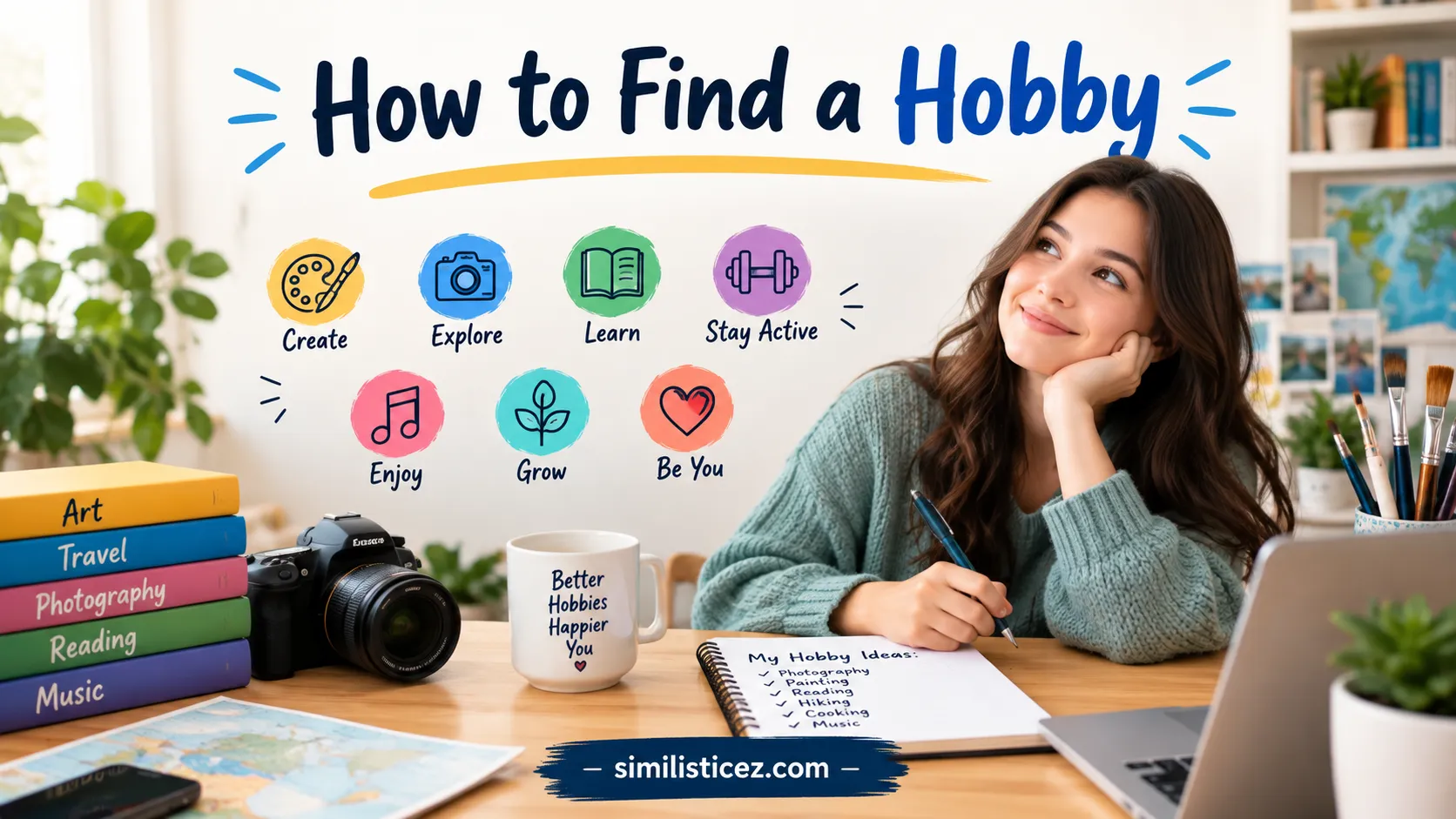
I used to wonder how people always seemed to have something fun to do in their free time. One day, I realized I had plenty of spare time but no real hobby to enjoy.
I tried a few random activities, but some felt boring while others were simply not for me. That made me search for how to find a hobby that actually matched my personality and lifestyle.
If you are in the same situation, you are not alone. Finding a hobby does not mean discovering one perfect activity immediately.
It is about trying different things until something feels enjoyable, meaningful, or relaxing.
Quick Answer:
To find a hobby, think about what you enjoy, consider your available time and budget, and try different activities until you discover something that genuinely interests you.
🧠 What Does “How to Find a Hobby” Mean?
The phrase “how to find a hobby” refers to looking for an enjoyable activity that you can regularly do during your free time. A hobby can be creative, physical, educational, social, relaxing, or even practical.
For example, you might enjoy:
- 📚 Reading books
- 🎨 Drawing or painting
- 📸 Photography
- 🍳 Cooking
- 🌱 Gardening
- 🏃 Running
- 🎮 Gaming
- 🎸 Playing an instrument
- ✍️ Writing
- 🧩 Solving puzzles
You do not need to be naturally talented at a hobby. The main purpose is to enjoy the process and give yourself something interesting to look forward to.
In short: How to find a hobby = explore your interests + try new activities + discover what you enjoy.
📱 Where Can You Look for Hobby Ideas?
You can discover hobby ideas almost anywhere. Your interests, friends, social media, and even things you enjoyed as a child can give you useful clues.
🔎 Search Online
You can search for hobby lists, beginner tutorials, videos, and communities based on your interests. Pinterest, YouTube, TikTok, Reddit, and hobby websites can expose you to activities you may never have considered.
👥 Ask Friends and Family
Your friends may already enjoy activities that could interest you. Ask them what they do in their free time or join them for a beginner-friendly activity.
📱 Explore Social Media
Social platforms are full of hobby communities. You might discover journaling, crochet, hiking, photography, cooking, collecting, fitness, or crafts simply by seeing someone else enjoy them.
🧠 Think About Your Personality
If you like quiet environments, reading, drawing, puzzles, or gardening may suit you. If you enjoy meeting people, sports, volunteering, dancing, or group classes could be worth trying.
🧒 Remember Childhood Interests
Think about activities you loved when you were younger. Maybe you enjoyed drawing, building things, collecting objects, playing sports, or writing stories. Those old interests can sometimes become great adult hobbies.
💬 Examples of Finding a Hobby in Real Life
Here are some realistic examples of how people might discover hobbies:
A: “i have so much free time lately 😭”
B: “why not try photography? 📸”
A: “i want something relaxing after work.”
B: “try painting or journaling 🎨”
A: “i need a hobby that gets me outside.”
B: “maybe hiking or gardening 🌱”
A: “i’ve always wanted to learn guitar.”
B: “then start with beginner lessons 🎸”
A: “nothing seems interesting to me.”
B: “try three completely different activities and see what sticks.”
A: “i want to meet new people too.”
B: “a local sports club or class could be perfect 😊”
A: “i don’t have much money for hobbies.”
B: “reading, walking, writing, and drawing can be almost free.”
These examples show an important point: finding a hobby is usually a process of experimentation, not a single decision.
🕓 When to Try a New Hobby and When Not to Force It
✅ When to Try a New Hobby
Consider trying a new hobby when:
- You have free time you want to use differently.
- You want a break from screens or work.
- You want to learn a new skill.
- You want a creative outlet.
- You want to meet new people.
- You need something relaxing.
- You want to become more physically active.
- You are curious about something you’ve never tried.
❌ When Not to Force a Hobby
You do not have to continue an activity simply because other people enjoy it.
Avoid forcing a hobby when:
- You genuinely dislike doing it.
- It creates unnecessary financial pressure.
- It takes more time than you can realistically give.
- You only chose it because it is currently popular.
- You feel stressed every time you do it.
- You are doing it only to impress other people.
A hobby should generally add something positive to your life rather than become another obligation.
Hobby Choice Comparison
| Situation | Hobby Example | Why It Works |
| Limited budget | Reading or walking | Very affordable |
| Stressful routine | Journaling | Calm and reflective |
| Need exercise | Cycling | Active and enjoyable |
| Want creativity | Painting | Encourages expression |
| Want social interaction | Team sports | Helps you meet people |
| Want a new skill | Cooking | Practical and rewarding |
🔄 Similar Ways to Think About Finding a Hobby
There are several approaches you can use instead of simply asking, “What is my hobby?”
| Approach | Meaning | When to Use |
| Explore your interests | Identify things you already like | When you feel unsure |
| Try something new | Experiment with unfamiliar activities | When your routine feels boring |
| Follow your curiosity | Learn about things that catch your attention | When many options interest you |
| Join a community | Try hobbies with other people | When you want social connection |
| Start small | Test an activity before committing | When you are hesitant |
| Return to old interests | Revisit childhood activities | When you cannot find new ideas |
🧭 How to Find a Hobby That Fits You
If you still do not know where to start, use this simple five-step method.
1. Make an Interest List
Write down everything you already enjoy. Include small things such as watching documentaries, listening to music, taking walks, organizing things, or trying recipes.
2. Identify Your Goal
Ask yourself what you want from your hobby. Do you want relaxation, exercise, creativity, social interaction, learning, or entertainment?
3. Pick Three Activities
Do not choose only one. Pick three different activities that seem interesting. This prevents you from assuming that your first choice must be perfect.
4. Try Each One
Give each activity a fair trial. You might spend a few hours drawing, attend a beginner class, cook a new recipe, or take a short hike.
5. Notice How You Feel
After trying each activity, ask yourself:
- Did I enjoy it?
- Did time pass quickly?
- Would I do it again?
- Did I feel relaxed or energized?
- Do I want to learn more?
Your answers can reveal which hobby is worth continuing.
❓ FAQs
1. How do I find a hobby I actually enjoy?
Start by listing your interests and trying several activities. You may need to experiment before finding something that feels right.
2. What if I have no interests?
Start with simple activities such as walking, reading, cooking, drawing, or photography. New interests can develop after you begin trying things.
3. How many hobbies should I have?
There is no correct number. One hobby can be enough, while other people enjoy several different activities.
4. Can a hobby be useful?
Yes. Cooking, gardening, photography, writing, coding, and learning languages can be both enjoyable and practical.
5. What are good hobbies for introverts?
Reading, writing, drawing, photography, gardening, puzzles, gaming, and learning an instrument can be good options for people who prefer quieter activities.
6. What are good social hobbies?
Team sports, dancing, volunteering, book clubs, classes, hiking groups, and community activities can help you meet people.
7. What hobbies are inexpensive?
Reading, walking, writing, drawing, meditation, bodyweight exercise, and learning from free online resources can cost little or nothing.
8. Can watching movies be a hobby?
Yes. Watching films can be a hobby, especially if you enjoy exploring different genres, directors, cultures, or film history.
9. Is gaming a hobby?
Yes. Gaming is a common leisure activity and can be enjoyed casually or socially.
10. What if I lose interest in my hobby?
That is completely normal. You can take a break, change your approach, or explore another activity.
11. How long should I try a hobby?
Try it enough times to move beyond the initial learning stage. Some hobbies become enjoyable only after you become more comfortable with them.
12. Should a hobby make me productive?
Not necessarily. A hobby can simply be something you enjoy. Rest and entertainment are valid reasons to have one.
13. Can I have a hobby at home?
Absolutely. Reading, cooking, painting, gaming, crafts, music, writing, and gardening can all be done at home.
14. How do I find a hobby as an adult?
Think about your interests, schedule, budget, and goals. Then test a few beginner-friendly activities.
15. Can my hobby become a career?
Sometimes. Writing, photography, cooking, art, coding, and other hobbies can develop into professional skills, although you do not need to turn every hobby into work.
16. What if I am not good at my hobby?
Being a beginner is normal. A hobby does not require professional-level skill.
17. Can hobbies reduce boredom?
Yes. Having enjoyable activities available can give your free time more variety and structure.
18. Should I choose a popular hobby?
Popularity does not matter as much as your personal interest. Choose something you genuinely enjoy.
19. How can I make time for a hobby?
Start with a small amount of time, such as 15–30 minutes a few times a week. Consistency is more important than spending hours on it.
20. What is the easiest way to find a hobby?
Make a list of your interests, choose three activities, try each one, and continue with the activity you genuinely enjoy.
🌟 Conclusion:
Learning how to find a hobby does not have to be complicated. You do not need to know immediately what your perfect hobby is.
Start with curiosity, explore several options, and pay attention to the activities that make you feel relaxed, excited, creative, or fulfilled.
Your hobby does not have to impress anyone else. It simply needs to be something that makes your free time feel more enjoyable.
Start small, experiment freely, and give yourself permission to change your mind. You may discover a new interest in the process.